

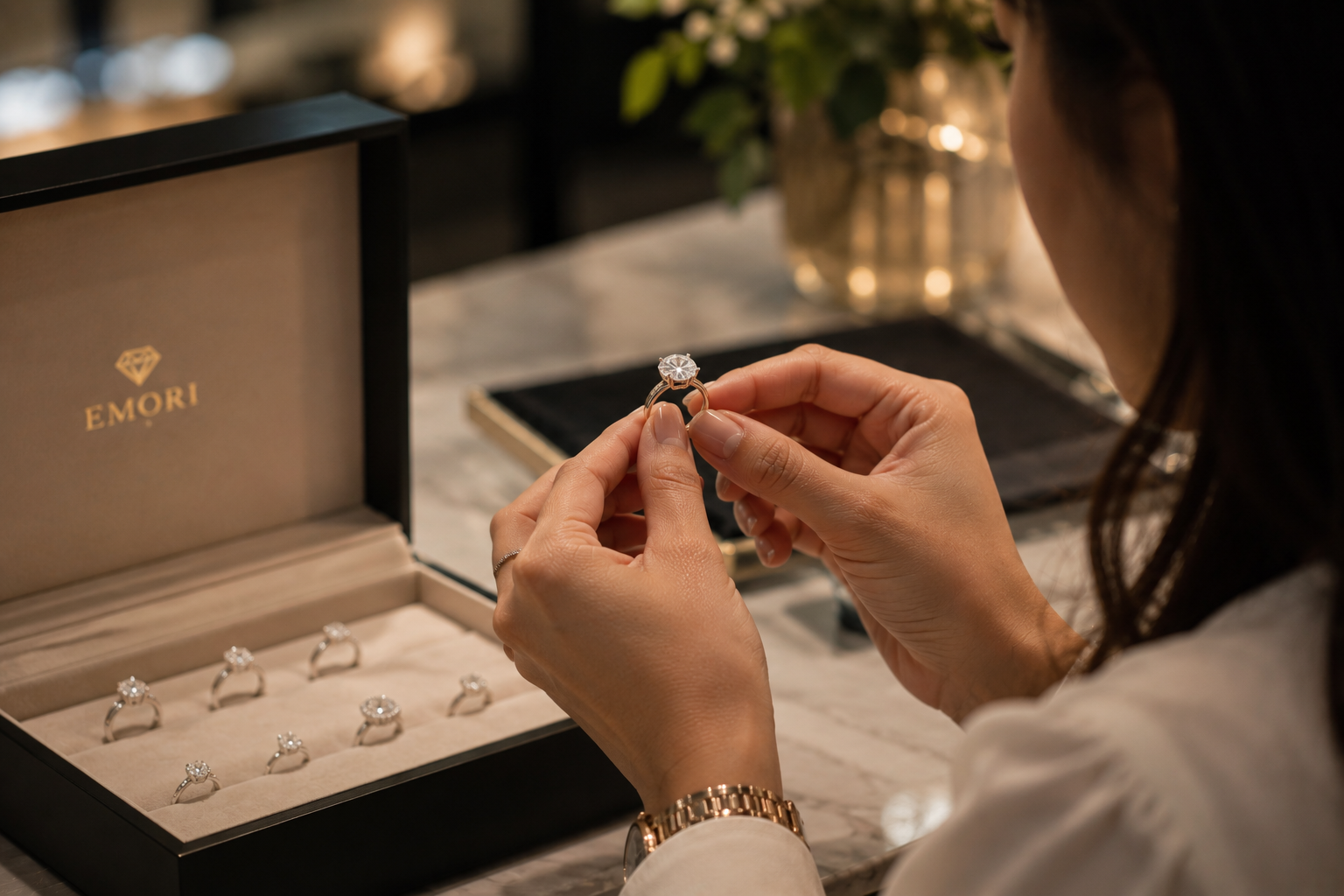
Lab grown diamonds are 60% to 90% cheaper than natural diamonds not because they are lower quality, but because they cost significantly less to produce. They are created in advanced laboratories instead of being mined from the earth, eliminating expensive mining operations, reducing supply chain costs, and allowing manufacturers to produce diamonds on demand. Despite the lower price, lab grown diamonds have the same chemical composition, crystal structure, hardness, and sparkle as natural diamonds.
The lower price of lab grown diamonds is driven by several production, economic, and supply chain factors rather than differences in quality. Here's a closer look at each reason.
Why Are Lab Grown Diamonds Cheaper?
The price difference isn't caused by a single factor. Instead, several production, economic, and supply chain advantages make lab grown diamonds significantly more affordable.
1. No Mining Means Lower Production Costs
Lab grown diamonds are cheaper because they eliminate the expensive mining process required for natural diamonds.
Natural diamonds require extensive exploration, excavation, heavy machinery, skilled labor, fuel, transportation, and environmental compliance before they can reach the market. These costs accumulate throughout the mining process and become part of the diamond's final price. Lab grown diamonds avoid these expenses because they are created in controlled laboratory environments using advanced technologies such as Chemical Vapor Deposition (CVD) and High Pressure High Temperature (HPHT), which replicate the conditions required for diamond formation.
By removing the need for costly mining operations, lab grown diamond manufacturers can significantly reduce production expenses and offer real diamonds at much lower prices.
2. Faster Production Reduces Manufacturing Costs
Lab grown diamonds are cheaper because they can be produced within weeks instead of taking billions of years to form naturally. Natural diamonds formed approximately 1–3 billion years ago under extreme heat and pressure deep within the Earth's surface. Their availability depends on rare geological processes, and finding these diamonds requires extensive exploration and mining operations before they can be brought to the market.
Lab grown diamonds recreate the same diamond-growing conditions in controlled laboratory environments using advanced technologies such as Chemical Vapor Deposition (CVD) and High Pressure High Temperature (HPHT). These methods allow manufacturers to produce gem-quality diamonds within approximately 3 to 8 weeks. By reducing the time required to create diamonds and improving production efficiency, lab grown diamond manufacturers can lower overall costs and offer real diamonds at significantly more affordable prices.
3. Advanced Manufacturing Makes Production More Efficient
Lab grown diamonds are more affordable because they are produced through a controlled manufacturing process that continues to become more efficient with technological improvements. Unlike natural diamond mining, where costs depend on exploration success, mining conditions, and resource availability, laboratory production follows a more predictable process. Manufacturers can monitor and optimize each stage of diamond growth to improve consistency and efficiency.
As technology advances, the lab grown diamond industry continues to improve through:
-
Better CVD equipment
-
Improved HPHT technology
-
Higher production yields
-
Reduced energy consumption
-
More efficient manufacturing processes
Similar to how improvements in technology have made electronics and other manufactured products more affordable over time, advancements in diamond-growing technology have helped reduce the cost of producing lab grown diamonds. As manufacturing processes become faster and more efficient, the cost of producing each lab grown diamond continues to decrease, making them more affordable for buyers.
4. Scalable Supply Helps Keep Prices Lower
Lab grown diamonds are cheaper because their supply can be increased according to market demand, unlike natural diamonds that depend on limited geological resources.
Natural diamond supply depends on discovering new deposits, developing mines, and extracting diamonds from the Earth. This process requires significant investment, takes years to complete, and is limited by the availability of natural diamond reserves. Lab grown diamonds, on the other hand, can be produced in laboratories based on consumer demand. Manufacturers can increase production capacity when demand rises without waiting for new discoveries or mining operations. A predictable and scalable supply reduces shortages and creates a more competitive market environment.
Because lab grown diamonds can be produced according to demand, their scalable supply helps maintain lower prices compared to naturally limited diamond resources.
5. Shorter Supply Chains Reduce Additional Costs
Lab grown diamonds are cheaper because they often move through fewer stages before reaching the customer, reducing additional markups along the way.
Natural diamonds typically pass through multiple stages before reaching the final buyer:
Mine → Rough Diamond Trader → Cutter → Wholesaler → Distributor → Retailer
Each stage involves operational costs, transportation expenses, labor, and profit margins, which gradually increase the final retail price of the diamond. Many lab grown diamond companies use shorter supply chains by working directly with manufacturers, retailers, or consumers. This reduces the number of intermediaries involved in the buying process. By simplifying the supply chain and reducing unnecessary markups, lab grown diamonds can reach customers at significantly lower prices.
6. Natural Diamonds Carry a Scarcity Premium
Natural diamonds are more expensive partly because their limited availability creates a rarity premium. Natural diamonds formed under unique geological conditions over billions of years, making them a finite natural resource. Their supply depends on existing diamond deposits and the ability to extract them through mining.
Lab grown diamonds do not have the same geological limitations. As long as manufacturers have the required technology and production capacity, they can continue producing diamonds to meet market demand. This difference in availability influences how the market values each type of diamond. Natural diamonds often command higher prices because of their rarity, history, and limited supply.
The higher price of natural diamonds is influenced not only by their physical properties but also by the scarcity associated with their natural origin.
7. Technology Continues to Reduce Lab Grown Diamond Costs
Lab grown diamonds have become more affordable because continuous improvements in technology have made production more efficient. The lab grown diamond industry has expanded significantly as manufacturers invest in advanced production methods and improved equipment. Innovations in diamond-growing technology have helped increase output while reducing manufacturing expenses.
Modern improvements include:
-
More advanced CVD equipment
-
Improved HPHT systems
-
Automation in production
-
Energy-efficient manufacturing methods
As production processes improve and manufacturers achieve greater efficiency, the cost of creating each diamond decreases. Ongoing technological advancements continue to make lab grown diamonds more affordable while maintaining the same physical and optical properties as natural diamonds.
If Lab Grown Diamonds Are Real, Why Are They Less Expensive?
Lab grown diamonds are less expensive not because they are fake or lower quality, but because they have a more efficient production process and lower manufacturing costs. A common misconception among buyers is that a lower price means a lab grown diamond is inferior. However, lab grown diamonds are real diamonds with the same:
-
Carbon crystal structure
-
Hardness of 10 on the Mohs scale
-
Brilliance, sparkle, and fire
-
Optical properties
The primary difference between natural and lab grown diamonds is their origin. Natural diamonds form beneath the Earth's surface over billions of years, while lab grown diamonds are created in controlled laboratory environments using advanced technology. The price difference comes from how the diamond is produced, not from what the diamond is made of.
Read: Are lab grown diamonds real diamonds?
Why Don't Lab Grown Diamonds Hold Their Resale Value?
Lab grown diamonds generally have lower resale values because production continues to become more efficient and new diamonds can be manufactured as demand grows. Natural diamonds tend to retain value better because their supply is limited by geological availability and mining constraints. Resale value depends on market demand, availability, and consumer preferences not on whether a diamond is real.
Natural Diamonds vs Lab Grown Diamonds
|
Feature |
Lab Grown Diamond |
Natural Diamond |
|
Origin |
Laboratory |
Earth's crust |
|
Formation Time |
3–8 weeks |
1–3 billion years |
|
Mining Required |
No |
Yes |
|
Chemical Composition |
Carbon |
Carbon |
|
Hardness |
10 Mohs |
10 Mohs |
|
Sparkle |
Same |
Same |
|
Supply |
Scalable |
Limited |
|
Typical Price |
60–90% lower |
Higher |
|
Resale Value |
Generally lower |
Generally higher |
Read: Resale value of lab grown diamonds
Are Lab Grown Diamonds Worth Buying?
Whether a lab grown diamond is worth buying depends on your priorities.
A lab grown diamond may be the better choice if you want:
-
A larger diamond within your budget
-
Higher clarity or colour for the same price
-
A certified real diamond at a lower cost
A natural diamond may appeal more if rarity, long-term collectability, or resale value are your primary considerations.Neither option is universally better; the right choice depends on your budget and preferences.
Does Cheaper Mean Lower Quality?
No. A certified lab grown diamond has the same carbon crystal structure, hardness, sparkle as a natural diamond. Both natural and lab grown diamonds are graded using the same 4Cs: cut, colour, clarity, and carat weight. Even professional gemologists require specialized equipment to determine whether a diamond is natural or lab grown. The primary difference is origin, not appearance or composition.
Lab grown diamonds are significantly cheaper than natural diamonds because they remove the costs associated with mining, use more efficient manufacturing processes, and follow a shorter supply chain. Their lower price does not come from lower quality—both natural and lab grown diamonds share the same chemical composition, crystal structure, hardness, and brilliance. The key difference is their origin, allowing buyers to choose based on their budget, values, and priorities.
Share:
Should You Prioritize Cut, Carat, Colour or Clarity? What Matters Most
Emori’s Lab Grown Diamond Jewelry: A Special Gift for Raksha Bandhan To Celebrate A Special Bond