

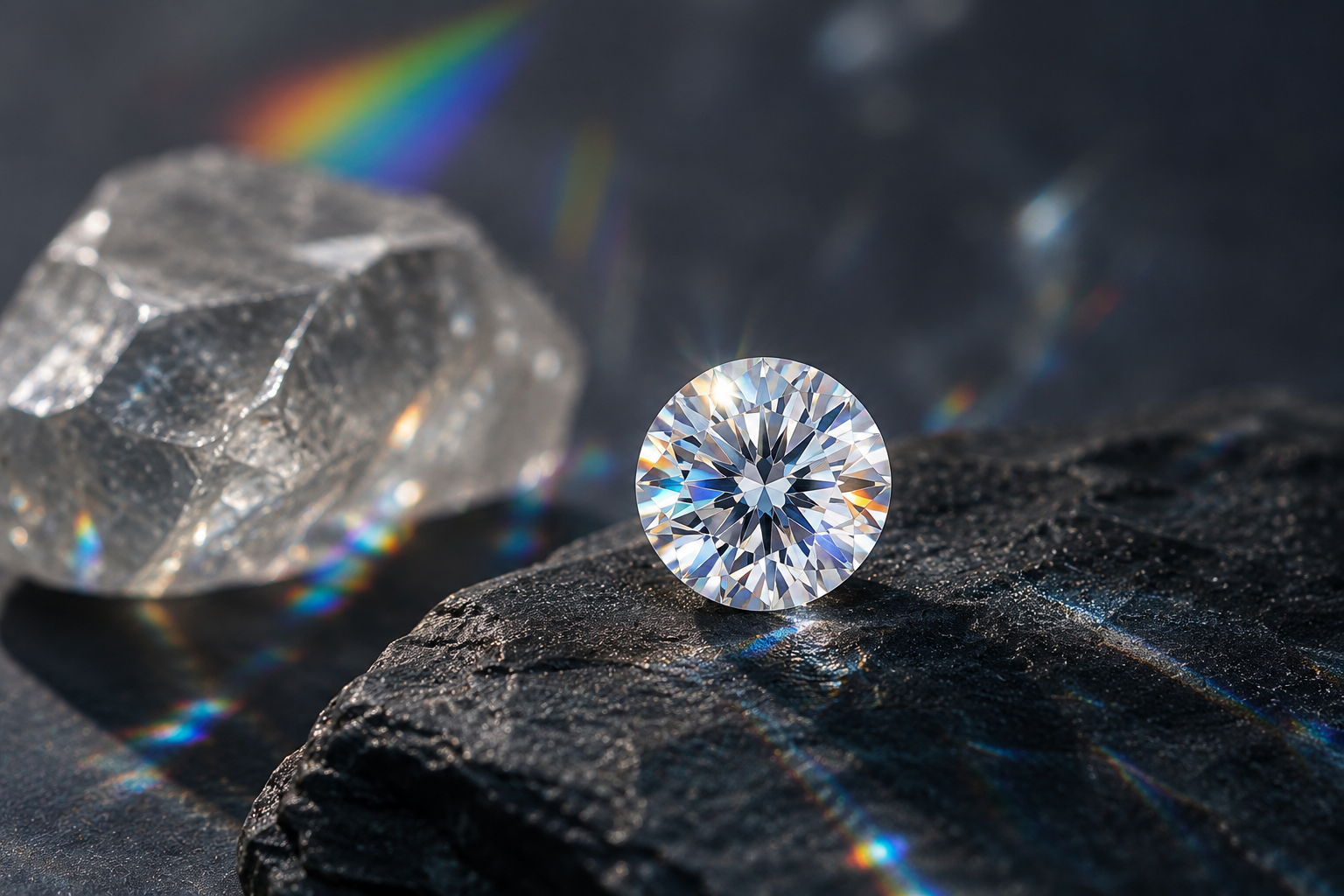
Is Moissanite a Real Diamond? Understanding Moissanite, Lab Grown Diamonds, and the Differences
Moissanite has become one of the most talked-about gemstones in modern jewellery, yet many people still aren't sure what it actually is. Some believe it is a type of diamond, others assume it is a fake diamond material, and many wonder whether moissanite and lab grown diamonds are the same thing.
The truth is that moissanite is a real gemstone, but it is not a diamond.
Originally discovered by French scientist Henri Moissan in 1893, natural moissanite is extremely rare. The moissanite used in jewellery today is almost entirely created in laboratories, making it widely available for use in rings, earrings, pendants, and other fine jewellery.
At first glance, moissanite can look very similar to a diamond because it is colourless, durable, and highly reflective. However, it has a different chemical composition, different optical properties, and different characteristics from both natural and lab grown diamonds.
This distinction is important because many shoppers researching moissanite are actually trying to answer bigger questions such as: Are moissanite diamonds real? Is moissanite a lab grown diamond? How does moissanite compare to a lab grown diamond? And is moissanite simply another type of fake diamond material?
In this guide, we'll explain exactly what moissanite is, how it differs from diamonds, whether it can be considered a real diamond, and how it compares with lab grown diamonds in terms of appearance, durability, value, and everyday wear.
What Is Moissanite?
Moissanite is a gemstone made of silicon carbide (SiC), a naturally occurring mineral known for its exceptional brilliance, durability, and resistance to scratching. Although it is often compared to diamonds because of its appearance, moissanite is a completely different gemstone with its own unique chemical composition and properties.
The story of moissanite began in 1893, when French chemist Henri Moissan discovered tiny crystals of silicon carbide while examining rock samples from a meteor crater in Arizona, USA. Initially, these crystals were mistaken for diamonds because of their remarkable sparkle. Further scientific analysis later revealed that they were an entirely different mineral, which was eventually named moissanite in honour of its discoverer.
Natural moissanite is extremely rare. In fact, gem-quality natural moissanite is so uncommon that it is not used for commercial jewellery production. Almost all moissanite available in jewellery today is created in laboratories using advanced manufacturing techniques that reproduce the gemstone's natural crystal structure.
This is one reason moissanite is often confused with lab grown diamonds. Both are typically created in laboratories and both can appear colourless and highly brilliant. However, they are fundamentally different gemstones. A lab grown diamond is a real diamond made of carbon, while moissanite is a silicon carbide gemstone with its own distinct characteristics.
Today, moissanite is widely used in engagement rings, earrings, pendants, and fashion jewellery because it offers impressive sparkle, strong durability, and a diamond-like appearance at a more accessible price point.
Where Does Moissanite Come From?
Natural moissanite is one of the rarest minerals found on Earth. Because it occurs in extremely small quantities, it is not practical to use natural moissanite in jewellery.
As a result, virtually all moissanite available today is created in laboratories. Using advanced manufacturing processes, scientists grow silicon carbide crystals under carefully controlled conditions to produce gemstones suitable for jewellery.
Lab-created moissanite offers several advantages over naturally occurring moissanite:
-
Consistent colour and clarity
-
Fewer visible inclusions
-
Greater availability for jewellery production
-
More uniform quality across different sizes and shapes
This controlled production process is why moissanite has become widely available in engagement rings, earrings, pendants, and other jewellery pieces. It allows jewellers to create gemstones that maintain the optical and physical properties that make moissanite popular while ensuring consistent quality.
Although most moissanite is lab-created, it is important to remember that moissanite and lab grown diamonds are not the same gemstone. They are created using different materials and different growth processes, despite both being produced in laboratory environments.
What Colour Is Moissanite?
Most moissanite used in jewellery today appears colourless or near-colourless to the naked eye. However, moissanite is available in several colour variations, and the exact appearance can differ depending on the quality of the stone, its size, and the lighting conditions.
The most common moissanite colour options include:
-
Colourless Moissanite: Bright white in appearance and designed to closely resemble high-colour natural and lab grown diamonds.
-
Near-Colourless Moissanite: May show faint hints of warmth, particularly in larger stones or under certain lighting conditions.
-
Yellow Moissanite: Displays a subtle to vivid yellow hue and is often chosen as a coloured gemstone rather than a diamond alternative.
-
Green Moissanite: Inspired by the natural green tint found in some rare moissanite crystals and selected for its unique appearance.
-
Blue Moissanite: Available in shades ranging from light blue to deeper ocean tones and often used in contemporary jewellery designs.
-
Grey Moissanite: A modern option that offers a distinctive smoky appearance and has become increasingly popular in alternative engagement rings.
Colour perception can also change with stone size. Larger moissanite gemstones may reveal more body colour than smaller stones, especially when viewed from the side.
Another characteristic that influences appearance is moissanite's high dispersion. This causes the gemstone to produce strong rainbow flashes of light, which can sometimes make colours appear more noticeable compared to natural or lab grown diamonds.
For buyers seeking the closest visual resemblance to a diamond, colourless moissanite is generally the preferred choice. Those looking for something more distinctive may choose yellow, blue, green, or grey moissanite to create a unique jewellery piece.
Why Is Moissanite So Popular?
Moissanite has grown in popularity over the years because it offers a combination of brilliance, durability, and affordability that appeals to many jewellery buyers. While it is not a diamond, it has developed a strong following among people who appreciate its unique characteristics.
One of the biggest reasons people choose moissanite is its sparkle. Moissanite has a higher refractive index than a diamond, which means it bends light more intensely and produces vibrant flashes of colour. Some people prefer this extra brilliance, especially in larger stones where the effect becomes more noticeable.
Durability is another factor behind moissanite's popularity. With a hardness of approximately 9.25 on the Mohs scale, moissanite is one of the hardest gemstones used in jewellery. This makes it suitable for everyday wear in rings, earrings, pendants, and bracelets.
Many buyers are also attracted to moissanite because it is available in a wide range of shapes and sizes. Whether someone is looking for a round brilliant stone, an oval cut, a cushion cut, or a pear shape, moissanite offers plenty of design flexibility.
Some of the key reasons people choose moissanite include:
-
Exceptional sparkle and fire
-
Strong durability for daily wear
-
Wide availability in different cuts and sizes
-
Consistent quality due to laboratory production
-
Lower cost compared to natural and lab grown diamonds
Ultimately, moissanite's popularity comes from offering an attractive balance of beauty, durability, and accessibility. While some buyers specifically want a diamond, others are drawn to moissanite for its own unique appearance and characteristics rather than as a diamond substitute.
Is Moissanite a Real Diamond?
No, moissanite is not a real diamond. Although it closely resembles a diamond in appearance, it is a different gemstone with its own chemical composition and characteristics.
The confusion exists because moissanite is colourless, highly durable, and exceptionally brilliant. To the average person, a moissanite gemstone can look very similar to a diamond when set in jewellery. However, gemologically speaking, moissanite and diamonds are two distinct gemstones.
Key Differences Between Moissanite and Natural Diamonds
-
Natural diamonds are made of pure carbon, while moissanite is made of silicon carbide.
-
Natural and lab grown diamonds are real diamonds, whereas moissanite belongs to a completely different gemstone category.
-
Moissanite often displays more colourful flashes of light than a diamond due to its higher refractive properties.
-
Real diamonds are slightly harder, ranking 10 on the Mohs hardness scale, while moissanite ranks approximately 9.25.
-
Both gemstones are suitable for everyday wear because of their excellent durability.
It is also important to understand that moissanite is not a fake gemstone. Many people use the term "fake diamond material" when referring to any stone that looks like a diamond but is not one. While moissanite can be used as a diamond alternative, it is a genuine gemstone with its own unique identity rather than an imitation diamond.
The simplest way to think about it is:
-
A natural diamond is a real diamond formed by nature.
-
A lab grown diamond is a real diamond created in a laboratory.
-
A moissanite is a real gemstone, but it is not a diamond.
Understanding this distinction helps buyers make informed decisions when comparing moissanite, natural diamonds, and lab grown diamonds.
Is Moissanite a Lab Grown Diamond?
No, moissanite is not a lab grown diamond.
This is one of the most common misconceptions among jewellery buyers because both moissanite and lab grown diamonds are often created in laboratories and can appear similar at first glance. However, they are completely different gemstones with different chemical compositions and properties.
A lab grown diamond is a real diamond. It has the same chemical composition, crystal structure, hardness, and optical properties as a natural diamond. The only difference is that it is grown in a laboratory rather than formed beneath the earth over billions of years.
Moissanite, on the other hand, is a gemstone made of silicon carbide. While it may resemble a diamond in appearance, it does not share the same composition or crystal structure as either natural or lab grown diamonds.
Moissanite vs Lab Grown Diamond: The Key Difference
-
Lab grown diamonds are made of pure carbon.
-
Moissanite is made of silicon carbide.
-
Lab grown diamonds are classified as real diamonds.
-
Moissanite is a separate gemstone species.
-
Both can be created in laboratories, but they are not the same material.
-
Lab grown diamonds are graded using the same standards as natural diamonds, while moissanite follows different grading systems.
| Feature | Moissanite | Lab Grown Diamond |
|---|---|---|
| Composition | Silicon Carbide (SiC) | Pure Carbon (C) |
| Gemstone Type | Independent Gemstone | Real Diamond |
| Hardness | 9.25 Mohs | 10 Mohs |
| Sparkle | More colourful flashes | Traditional diamond brilliance |
| Certification | Limited gemstone grading | IGI, GIA and other diamond labs |
| Origin | Usually lab-created | Lab-created |
| Appearance | Diamond-like | Identical to natural diamond |
| Price | Generally lower | Higher than moissanite, lower than natural diamonds |
A simple way to understand the difference is to focus on what the gemstone is made of rather than how it is created. The term "lab grown" describes the origin of a gemstone, while "diamond" describes its composition. A lab grown diamond remains a diamond because it is made of carbon. Moissanite remains moissanite because it is made of silicon carbide, regardless of where it was created.
This distinction becomes important when comparing moissanite vs lab grown diamonds. While both are popular alternatives to mined diamonds, they differ in their sparkle, durability, composition, and overall appearance.
Many jewellery brands offer both moissanite and diamond jewellery. Others, including Emori, focus exclusively on certified lab grown diamonds for customers specifically looking for real diamonds rather than diamond alternatives.
Understanding these differences can help buyers choose the gemstone that best matches their preferences, expectations, and budget.
Does Moissanite Lose Its Sparkle?
No, moissanite does not lose its sparkle over time.
One of the reasons moissanite is popular in jewellery is that its brilliance is a permanent property of the gemstone itself. Unlike certain materials that can become dull, fade, or lose their appearance with age, moissanite retains its optical properties throughout its lifetime.
The sparkle of moissanite comes from its crystal structure and high refractive index, which determine how light passes through and reflects within the stone. Since these properties do not change with normal wear, a moissanite gemstone will continue to produce the same brilliance and fire years after it is purchased.
So why do some people believe moissanite loses its sparkle?
In most cases, the issue is not the gemstone itself but the buildup of everyday substances such as:
-
Hand creams and lotions
-
Soap residue
-
Dust and dirt
-
Skin oils
-
Cosmetic products
Over time, these can form a thin layer on the surface of any gemstone, reducing its ability to reflect light effectively. The same thing can happen to natural diamonds and lab grown diamonds.
Fortunately, regular cleaning is usually enough to restore a moissanite's appearance. A gentle cleaning with warm water, mild soap, and a soft brush can help remove buildup and bring back its original brilliance.
In short, moissanite does not become cloudy, fade, or lose its sparkle permanently. With basic care and occasional cleaning, it can maintain its brilliance for decades.
Moissanite is a unique gemstone with a fascinating origin, exceptional brilliance, and impressive durability. While it is often compared to diamonds because of its appearance, moissanite is not a diamond and should not be confused with either natural or lab grown diamonds.
Understanding the difference is important when shopping for jewellery. A lab grown diamond is a real diamond made of carbon, while moissanite is a gemstone made of silicon carbide. Both offer their own advantages, and the right choice depends on your personal preferences, budget, and what you value most in a gemstone.
If your goal is to own a real diamond with the same composition, hardness, and brilliance as a natural diamond, a certified lab grown diamond may be the better fit. If you are looking for a durable gemstone known for its intense sparkle and accessibility, moissanite remains a popular choice.
Ultimately, neither gemstone is about being right or wrong. They are different products designed for different buyers. The key is understanding what each gemstone is and making an informed decision based on facts rather than misconceptions.
Share:
Are Lab Grown Diamonds Real Diamonds?
10 Unique Diamond Mangalsutra Designs for the Modern Bride