
When comparing diamonds, clarity is one of the most misunderstood factors. Terms like VVS, VS, VVS1, and VS2 often appear on diamond certificates, yet many buyers are unsure what these grades actually mean or whether paying more for higher clarity makes a visible difference.
The confusion becomes even greater when comparing VVS and VS diamonds. Both are considered high-clarity grades, both appear eye-clean in everyday wear, and both are commonly used in engagement rings, pendants, earrings, and other fine jewellery. Yet the difference in price can be significant.
In this guide, we'll explain what VVS and VS diamonds are, how clarity is graded, what diamond inclusions actually mean, and whether a higher clarity grade is worth the additional investment. By the end, you'll have a clear understanding of how these grades compare and which option offers the best value for your needs.
What Clarity Means in a Diamond?
Clarity refers to the presence of tiny natural marks inside or on the surface of a diamond. These marks are called inclusions and blemishes. Every diamond has them because they form naturally under heat and pressure.
Clarity grading tells you how visible these marks are under magnification.
The clarity scale goes from Flawless at the top to Included at the bottom. VVS and VS sit in the higher middle part of the scale. Both grades offer excellent quality for real jewellery buyers.
What Are Diamond Inclusions?
Diamond inclusions are small internal characteristics that form while a diamond is growing. Whether a diamond is created naturally beneath the earth's surface or grown in a laboratory, the formation process takes place under extreme conditions. During this process, tiny crystals, growth patterns, or trace elements can become trapped within the diamond structure, creating what gemologists refer to as inclusions.
A diamond is composed of approximately 99.95% carbon. The remaining fraction may contain trace elements or internal growth characteristics that contribute to the appearance of inclusions. These inclusions are one of the key factors used by grading laboratories such as IGI and GIA when determining a diamond's clarity grade.
It is also important to distinguish between inclusions and blemishes. Inclusions are internal characteristics found within the diamond, while blemishes are external marks that appear on the surface. Both influence clarity grading, but they are assessed differently during the grading process.
In higher clarity grades such as VVS and VS, inclusions are typically microscopic and invisible to the naked eye. The main difference between these grades is how easily those inclusions can be located under 10x magnification. This is why clarity grading focuses not only on the presence of inclusions, but also on their size, number, position, and visibility.

What Are VVS Diamonds?
VVS diamonds are diamonds that fall into the Very Very Slightly Included (VVS) clarity category. This means they contain extremely small inclusions that are difficult for even trained gemologists to locate under 10x magnification. Because these inclusions are so minute, VVS diamonds appear completely eye-clean and flawless to the naked eye.
On the diamond clarity scale, VVS diamonds rank just below Flawless (FL) and Internally Flawless (IF) diamonds, making them one of the highest clarity grades available. The VVS category is further divided into two grades:
-
VVS1: Inclusions are extremely difficult to detect, even for experienced graders.
-
VVS2: Inclusions remain very small but may be slightly easier to locate under magnification.
One of the reasons VVS diamonds are highly valued is their rarity. Most diamonds contain natural internal characteristics formed during the growth process, but only a small percentage qualify for a VVS clarity grade. This makes VVS diamonds particularly appealing to buyers who appreciate exceptional clarity and precision.
It is important to note that VVS clarity does not automatically mean a diamond will sparkle more. A diamond's brilliance and fire are primarily determined by its cut quality. The advantage of a VVS diamond lies in its exceptional purity and the fact that its inclusions have virtually no visible impact on appearance.
For most jewellery buyers, a VVS diamond offers peace of mind, knowing they are choosing one of the highest clarity grades available while still enjoying a diamond that looks perfectly clean in everyday wear.
VVS Full Form in Diamonds
The VVS full form in diamonds is Very Very Slightly Included. It is a premium diamond clarity grade used by gemological laboratories such as IGI and GIA to describe diamonds that contain extremely small inclusions. These inclusions are so minor that even trained graders often need time and magnification to locate them.
When buyers search for what is VVS, they are usually trying to understand how clean and valuable a VVS diamond is. In simple terms, a VVS diamond appears completely eye-clean and sits among the highest clarity grades available, just below Flawless (FL) and Internally Flawless (IF) diamonds.
What Is VVS Clarity?
VVS clarity refers to diamonds with inclusions that are extremely difficult to detect under 10x magnification. On the diamond clarity scale, VVS sits above VS (Very Slightly Included) and SI (Slightly Included) grades, making it one of the most sought-after clarity categories.
Many buyers asking what is VVS clarity assume it directly affects sparkle. In reality, a diamond's sparkle depends primarily on its cut quality. The advantage of VVS clarity is that the inclusions are so small that they have virtually no visible impact on the diamond's appearance, allowing the stone to maintain a remarkably clean and pure look.
How Good Is VVS Diamond Quality?
VVS diamond quality is considered excellent because the inclusions are extremely small and do not affect how the diamond looks to the naked eye. Whether you're viewing a solitaire ring, pendant, or pair of earrings, a VVS diamond appears clear, bright, and eye-clean.
One reason VVS diamonds are highly valued is their rarity. Finding a diamond with such minimal internal characteristics is uncommon, which contributes to its premium positioning in the market.
However, experienced jewellers often advise buyers to consider cut, colour, clarity, and carat weight together rather than focusing solely on clarity. Understanding these factors together provides a more complete picture of a diamond's quality. You can learn more in our guide to the 4Cs of diamonds.
For most jewellery buyers, both VVS diamonds and high-quality VS diamonds will appear equally beautiful in everyday wear. The difference becomes noticeable mainly under magnification, where the superior diamond VVS clarity grade can be appreciated by trained professionals.
VVS1 vs VVS2: Understanding the Difference
Both VVS1 and VVS2 diamonds belong to the Very Very Slightly Included (VVS) clarity category and are considered exceptionally high clarity grades. The difference lies in the size, number, and location of the inclusions found within the diamond.
A VVS1 diamond contains inclusions that are extremely difficult for even an experienced grader to locate under 10x magnification. A VVS2 diamond may contain slightly more noticeable inclusions, but they remain very difficult to detect and are still invisible to the naked eye.
For most jewellery buyers, there is no visible difference between VVS1 and VVS2. Both appear perfectly eye-clean in rings, earrings, pendants, and bracelets. The choice usually comes down to personal preference and budget rather than appearance.
What Are VS Diamonds?
VS stands for Very Slightly Included, a diamond clarity grade that sits just below VVS on the diamond clarity scale. VS diamonds contain small inclusions that are visible under magnification but remain invisible to the naked eye in most cases.
Because they appear eye-clean while costing less than VVS grades, VS diamonds have become one of the most popular choices among jewellery buyers. Many gemologists and diamond experts consider VS clarity to be the sweet spot between clarity and value.
There are two types of VS Clarity Diamonds:
- VS1
- VS2
VS diamonds give you a clean and bright appearance without paying a premium for perfection. Most buyers prefer VS because it gives the right balance between beauty and cost.
What Is VS Diamond Clarity?
VS diamond clarity is divided into two categories:
- VS1: Contains very small inclusions that are difficult to locate under magnification.
- VS2: Contains slightly more noticeable inclusions under magnification but still appears clean in normal viewing conditions.
For everyday jewellery such as engagement rings, pendants, earrings, and bracelets, both VS1 and VS2 diamonds typically look identical to higher clarity grades without magnification.
VS1 vs VS2: Is There a Noticeable Difference?
Like the VVS category, VS clarity is also divided into two grades: VS1 and VS2.
A VS1 diamond contains smaller and fewer inclusions than a VS2 diamond, making them slightly harder to locate under magnification. A VS2 diamond may contain inclusions that are somewhat easier for a trained gemologist to identify, but they still remain invisible during normal viewing.
In practical terms, both VS1 and VS2 diamonds look clean and bright once set into jewellery. This is why many buyers focus more on cut quality and overall appearance rather than choosing between VS1 and VS2.
How Good Are VS Diamonds?
One of the biggest misconceptions about VS diamonds is that they are visibly inferior to VVS diamonds. In reality, most buyers cannot distinguish between a VS and VVS diamond without professional equipment.
This is why many diamond professionals recommend VS clarity, especially when shopping for larger carat sizes. Instead of paying a premium for clarity improvements that are difficult to see, buyers can often invest in a larger diamond or a better cut grade while maintaining an eye-clean appearance.
How VVS and VS Look in Real Life
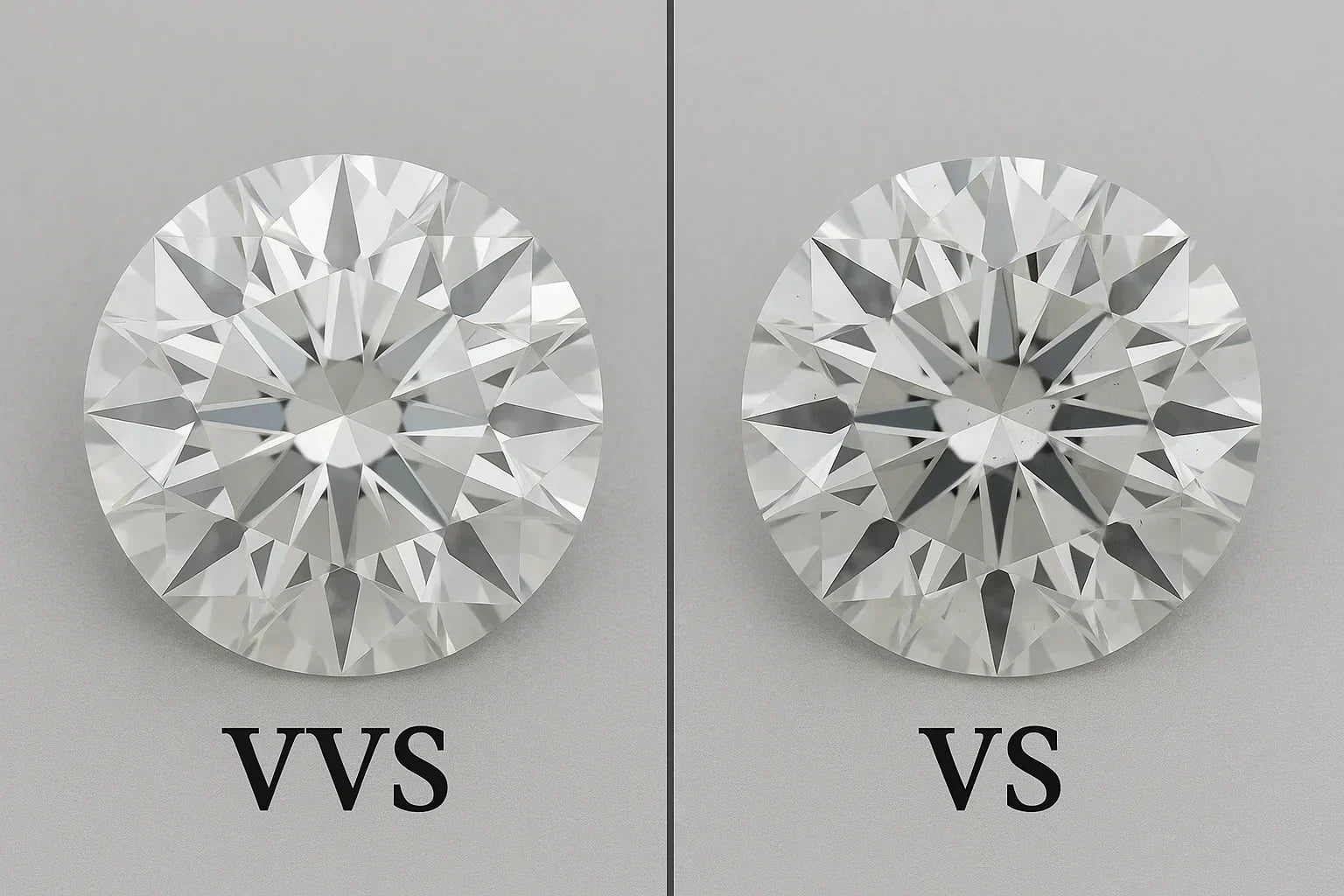
To the naked eye, both VVS and VS look the same. They appear clear and bright because their inclusions are too small to be seen without magnification.
The difference appears only under professional tools. Under magnification
- A VVS diamond may show one extremely tiny pinpoint
- A VS diamond may show a few slightly larger inclusions depending on their type and placement
The most important thing to remember is that these differences do not change the way the diamond looks in jewellery. Whether you wear it on the hand, neck, wrist or ears, both grades look eye clean.
| Feature | VVS Diamonds | VS Diamonds |
|---|---|---|
| Full Form | Very Very Slightly Included | Very Slightly Included |
| Visibility of Inclusions | Extremely difficult to detect | Difficult to detect |
| Eye-Clean Appearance | Yes | Yes |
| Sparkle | Depends on cut quality | Depends on cut quality |
| Rarity | Higher | More common |
| Price | Higher | More affordable |
| Best For | Buyers seeking exceptional clarity | Buyers seeking the best value |
Shop Our Collections
Price Differences Between VVS and VS
The price gap between VVS and VS becomes noticeable once you compare stones of similar size. VVS diamonds are rarer because they have very few internal marks and sit close to the flawless category. This rarity gives them a higher price.
VS diamonds offer the same clean appearance to the naked eye but do not carry the rarity premium, which is why they feel more practical for many buyers.
The price difference becomes larger as the carat size increases. For example
- In diamonds under one carat, the difference is present but still manageable
- In larger sizes, even a small clarity improvement becomes rare, so VVS prices rise sharply
This is why many buyers choose VS for bigger solitaire rings or statement jewellery. They get the same clean look while keeping the budget comfortable. It allows them to invest more in size or cut without compromising appearance.
How Clarity Affects Beauty and Sparkle
Clarity affects how clean the diamond looks, but it does not control sparkle. Sparkle depends entirely on the type of diamond cut.
- A well cut VS diamond will shine more than a poorly cut VVS diamond.
- This is important because many people assume higher clarity means more shine, but these are two separate factors.
- If you want maximum sparkle, always focus on cut first, then clarity.
Which One Should You Choose for Jewellery
For engagement rings
- VS is usually the best choice because it balances beauty and price. It looks clean and clear even in larger sizes. Many buyers comparing VVS and VS clarity grades do so while shopping for engagement rings.
- VVS is ideal for someone who prefers near perfect clarity and does not mind spending more.
For earrings
- VS works very well because earrings are seen from a distance. The inclusions are never visible.
- VVS is not necessary unless you want a premium choice.
For necklaces and pendants
- VS is excellent since the diamond is viewed from a normal distance.
- VVS can be chosen for solitaire pendants where the entire focus is on one stone, but it is not essential.
For bracelets
- VS is ideal because bracelets move and sparkle, and minor inclusions are never seen.
- VVS becomes unnecessary unless the design features one large centre stone.
When a VVS Diamond Makes Sense
A VVS diamond becomes a good choice when clarity is an important part of what you value in a diamond. It suits buyers who want a stone that feels as close to perfect as possible. Below are situations where VVS clarity truly makes sense.
You want a diamond that stays visually clean even under magnification:
Some buyers enjoy knowing that their diamond looks spotless not only to the eye but also when viewed closely. If you appreciate this level of purity, a VVS diamond fits well.
You prefer a high clarity grade for personal satisfaction:
Certain people enjoy owning a diamond that ranks at the top of the clarity scale. It gives a sense of assurance and pride, especially when choosing something meaningful like an engagement ring or a keepsake piece.
You are buying a smaller carat size and want the best possible appearance:
In smaller diamonds, the price gap between VS and VVS is not very large. This makes it easier to choose VVS without stretching the budget. Small stones with higher clarity often look extra crisp and bright.
You want a diamond that holds emotional or long term value:
Some buyers choose VVS because they see their diamond as a long term piece, maybe something they want to pass on later. High clarity often feels more special and timeless for this purpose.
You are picking a design where the diamond is the main focus:
For solitaire rings, single stone pendants or minimal jewellery where the entire attention sits on one diamond, VVS clarity can create a very clean look.
When a VS Diamond Is the Smarter Choice
A VS diamond makes sense when you want a diamond that looks clean without overspending. To the naked eye, a VS diamond appears clear and bright, so there is no difference in beauty compared to VVS.
VS becomes especially smart when you are choosing a larger size. The price jump to VVS gets much bigger as the diamond becomes larger, so many buyers prefer to put that budget into better cut quality or a slightly bigger stone.
If your goal is to balance value, beauty and size, a VS diamond fits perfectly. It gives you a clean look, keeps your budget in control, and performs beautifully in any type of jewellery. This is why VS remains one of the most recommended clarity grades for engagement rings and daily wear pieces.
Final Thoughts
Both VVS and VS diamonds offer high clarity and beautiful appearance. To the eye, both look equally clean, and the differences appear only under magnification. Most customers choose VS because it gives excellent value and looks perfect in jewellery. VVS is ideal for someone who wants near perfection and does not mind paying a premium for the highest clarity look.
The most important thing is to choose a well cut diamond, because cut controls sparkle. Once the cut is right, both VVS and VS clarity grades will shine beautifully in any ring, necklace, earring, or bracelet.
FAQs
What Inclusions Are Found in VVS and VS Diamonds?
The inclusions found in VVS and VS diamonds are usually tiny internal characteristics formed during the diamond growth process. Common examples include crystal inclusions, pinpoint inclusions, clouds, feathers, and microscopic growth marks.
In a VVS diamond, these inclusions are so small that even trained gemologists often need time to locate them under magnification. In a VS diamond, the inclusions may be slightly easier to identify under a loupe but remain invisible during normal wear. In most cases, these characteristics have no impact on the beauty or durability of the diamond.
How Do Inclusions Form Inside a Diamond?
Diamonds form under extreme conditions, whether deep within the earth or in a controlled laboratory environment. During this growth process, tiny minerals, growth patterns, or microscopic irregularities can become trapped inside the crystal structure.
These natural growth characteristics are what gemologists refer to as inclusions. In fact, almost every diamond contains some form of inclusion. Completely flawless diamonds are exceptionally rare, which is why they command significantly higher prices.
Do Lab Grown Diamonds Have Inclusions?
Yes. Lab grown diamonds can also contain inclusions because they are real diamonds with the same crystal structure as mined diamonds. The difference is that the inclusions may originate from the laboratory growth process rather than geological formation.
Just like mined diamonds, lab grown diamonds are graded for clarity by independent laboratories such as IGI. This means a lab grown diamond can be VVS, VS, SI, or any other recognised clarity grade depending on the visibility of its inclusions.
Understanding the differences between lab grown diamonds and real diamonds can help buyers make a more informed decision.
Can Inclusions Affect a Diamond's Strength?
Most inclusions found in VVS and VS diamonds do not affect durability. These clarity grades are considered high quality, and the inclusions are usually too small to create any structural concerns.
Potential durability issues are more commonly associated with lower clarity grades where larger feathers or fractures may be present. For VVS and VS diamonds, durability is generally not a concern for everyday jewellery.
Why Are VVS Diamonds More Expensive?
VVS diamonds are more expensive because they are significantly rarer than VS diamonds. The inclusions are so small that only a small percentage of diamonds qualify for a VVS grade.
This rarity increases their value even though the visual difference between VVS and VS diamonds is usually impossible to see without magnification. Buyers are often paying for scarcity, grading prestige, and exceptional clarity rather than a noticeable difference in appearance.
Which is better: VVS1, VVS2, VS1, or VS2?
VVS1 has the highest clarity among these grades, followed by VVS2, VS1, and VS2. While these differences are important in professional grading, most buyers will not notice a visible difference once the diamond is set into jewellery. Cut quality, carat weight, and overall appearance often have a greater impact on how the diamond looks in real life.
Do VVS diamonds sparkle more than VS diamonds?
Not necessarily. A diamond's sparkle is primarily determined by its cut quality rather than its clarity grade. A well-cut VS diamond can often appear more brilliant than a poorly cut VVS diamond. Clarity affects how clean a diamond appears, while cut affects how it reflects light.
Share:
The Ultimate Guide to Diamond Facets