

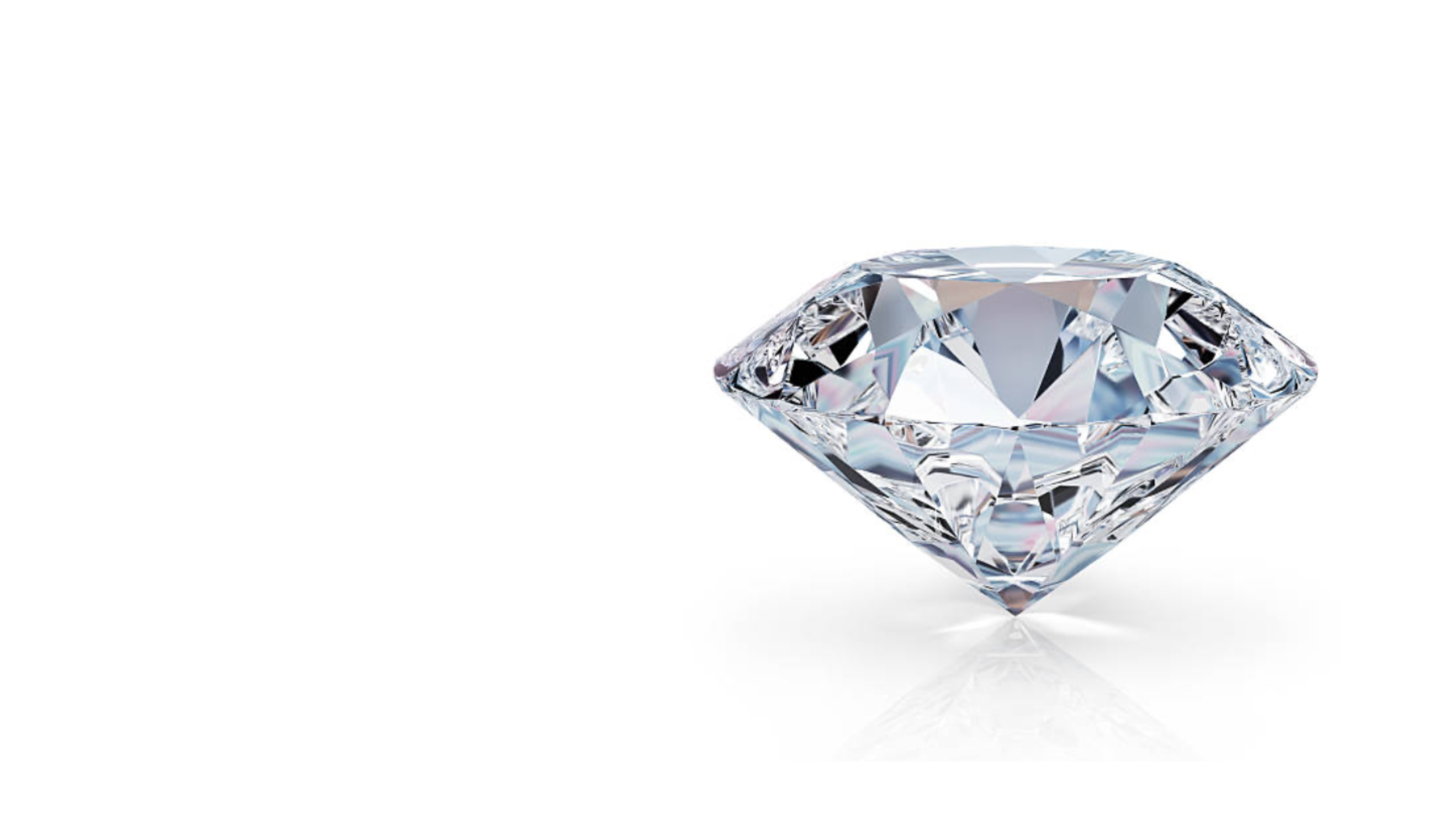
A diamond, as you must know, is judged on the basis of 4Cs - Cut, Color, Clarity and Carat. Each element is measured differently on a scale which is specifically designed to assess a specific element.
Your curiosity about the 4Cs has landed you on this page, which tells us you are either plainly wondering or entertaining the thought of buying a diamond that invites a slow, knowing lift of the brow from every gaze it meets.
So, if you want to know what are the 4Cs of diamonds, then worry not because you are only 4 seconds away from knowing the answer to this question and a couple of minutes away from understanding the best way to know the quality of a diamond.
The 4Cs of Diamonds
Let’s quickly take a look at each one to understand how these elements impact a diamond’s aesthetic as well as monetary value.
Cut
Diamond cut is often confused with diamond shape; while shape defines the outline of a gem, such as pear, oval or baguette, cut refers to how it was faceted and crafted to reflect light.
One can safely say that cut is what gives a diamond its character. Cut is responsible for rendering diamond sparkle and brilliance, which the diamond is cherished and treasured for. Yes, we are referring to that scintillating effect which makes the diamond twinkle with tiny, captivating rainbow flashes.
For a diamond to display fire-like colors and achieve optimal performance, the gemstone needs to be masterfully cut; neither too deep, nor too shallow, but rather with perfection and precision, just so the light could enter and dazzle right back with maximum intensity, revealing a gem’s true presence.
To understand this better, explore our detailed guide on different types of diamond cuts.
Color
This element helps us determine the degree of a diamond’s color, or lack thereof. The modern color grading scale of evaluating a diamond ranges from D, being completely colorless, pure icy and therefore the finest quality of diamond, to Z, which is a faint yellow, or almost on the verge of being a brownish hue.
As per the diamond color quality chart, D-F are classified as colorless, G-J as near-colorless, K-M as slightly tinted, N-R as very light color and S-Z as light color.
Emori’s lab-grown diamonds lie in the D-F range, placing them in the colorless category. The diamonds appear exceptionally pure white to the eye, giving the gemstones a lasting luminous finish.
Colors that fall outside of this category with vivid hues and tints of, say, pink, green, blue or red, are considered ‘fancy’ diamonds.

Clarity
Clarity tells us how free a diamond is from tiny marks. The marks are divided into two categories. The ones that are found on the surface of a diamond are called blemishes, and the ones that are inside a diamond are known as inclusions. Both inclusions and blemishes are formed during the crystallisation process.
These marks are studied under 10x magnification by experts in order to assess a diamond’s quality. During the said process, several factors, including number, size, color and the position, are carefully noted.
If a diamond does not have any blemishes or inclusions, it is put under the category of Flawless and is considered to be the highest quality of diamond. A gem with minor and off-centre flaws, which are only visible through a microscope, is graded within the IF (Internally Flawless), VVS (Very Very Slightly Included) or VS (Very Slightly Included) ranges.
Inclusions and blemishes that are noticeable and in some cases, very much visible to the naked eye come under SL (Slightly Included) and I (Included) ranges.
Emori strictly maintains VVS-VS clarity to offer you a range of diamonds that are remarkable, radiant and refined.
 Carat
Carat
The carat is used to measure the weight of a diamond and not its size. Many people get these terms mixed up, so let’s try to understand the difference. One carat equals 0.2 grams (200 milligrams), an incredibly small unit of weight that makes such a big difference when it comes to a diamond’s appearance.
There is a broad spectrum of diamonds from different carats, ranging from light ones such as the 0.25ct diamond to 0.50ct, 1ct, 2ct, and other higher carat diamonds.
However, a diamond’s size alone cannot determine its impact. There are so many different qualities of diamonds. Even two gemstones that have equal carat values can be totally different when it comes to their appearance, because one might just release light easily, while another might hold it back.
As carat weight increases, diamonds become rarer, which is exactly why their value rises so quickly. Larger stones are not just bigger; they are simply harder to come by.
But know, the most beautiful diamonds are not always the heaviest. A well-cut, slightly smaller stone can shine just as brightly, sometimes even more, as we explained, than a larger one which is not cut well.
At Emori, we bring the 4Cs together as a guide to help you choose with clarity and confidence. Every lab-grown diamond in our collection is designed to reflect exceptional brilliance, thoughtful craftsmanship, and conscious luxury, so you can focus on what truly matters: how it feels, how it shines, and how it becomes a part of your story. With Emori, choosing a diamond is not just about grading, but about finding a piece that feels beautifully, intentionally and uniquely yours. For more insights into lab-grown diamonds, check out our blog on debunking myths about lab-grown diamonds.
FAQs
1. Are lab grown diamonds graded using the same 4Cs as natural diamonds?
-
Yes, lab grown diamonds are evaluated using the same 4Cs: Cut, Color, Clarity, and Carat.
2. Do E-F color diamonds look different from D color diamonds?
-
D color diamonds seem almost similar to E–F color diamonds, as all three fall within the colorless range. Only an expert can note the difference between them.
3. Why does clarity matter if inclusions are not entirely visible to the naked eye?
-
Clarity plays an important role because it affects how light moves inside a diamond. Even though you can’t spot inclusions, they still impact the brightness and brilliance of a diamond.
4. Can two diamonds with the same carat look different?
-
Even if two diamonds have the same carat weight, they can definitely look different depending on their respective cut and shape.
5. Are lab grown diamonds considered real diamonds in grading systems?
-
Yes, lab grown diamonds are chemically, physically and optically identical to mined diamonds, which is why they are graded using the same international certification standards.
Share:
How to Clean and Care for Diamond Solitaire Earrings
Lab Grown vs. Natural Diamonds: Are They Different?