

When people talk about diamonds, they often mention size, shape, or price. But what truly decides whether a diamond looks alive or lifeless is something far more detailed: its facets.
Diamond facets are not just technical cuts done for appearance. They are the result of years of gem science, craftsmanship, and understanding how light behaves. Every small flat surface on a diamond has a purpose. When it's done right, facets turn a transparent crystal into a stone that reflects light, creates sparkle, and feels special every time you look at it.
This guide goes deep into diamond facets, explained in simple language, so you truly understand what you are paying for and why one diamond can look better than another even when they seem similar on paper.
What Exactly Is a Diamond Facet?

A diamond facet is a flat, polished surface cut onto a diamond. These surfaces are angled and positioned in a very specific way to control light.
Diamonds do not shine on their own. They rely completely on light. When light enters a diamond, it hits the facets, bends, reflects, and then exits back through the top. The way this happens depends entirely on how those facets are cut.
You can think of facets as carefully placed windows and mirrors inside the diamond. Each one plays a role in guiding light where it needs to go.
Why Facets Are the Foundation of a Diamond’s Beauty
Two diamonds can have the same weight, same shape, and even the same clarity, yet look completely different. The reason is almost always the facets.
Facets decide:
-
How much light enters the diamond
-
How long light stays inside
-
How much light returns to your eyes
-
Whether light escapes or is reflected properly
When facets are cut correctly, the diamond looks bright, balanced, and lively. When they are not, the diamond may look glassy, dark in places, or flat. In fact, cut is one of the four key factors used to evaluate a diamond's overall quality. You can learn more in our guide to the 4Cs of diamonds.
Understanding the Structure of a Diamond Through Its Facets
To understand diamond facets, you must understand the structure of the diamond.

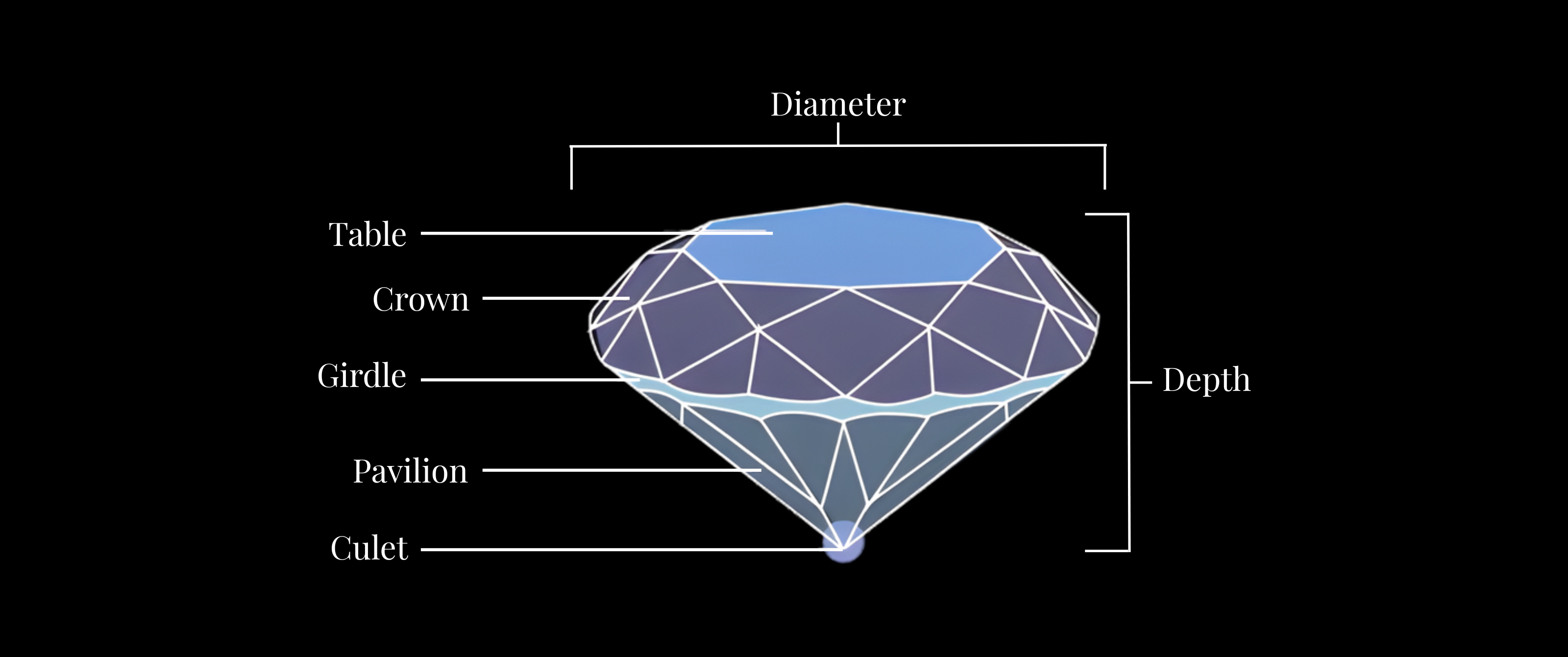
The Table
The table is the largest facet on the top. It is the main entry point for light.
A table that is too large can reduce sparkle. A table that is too small can limit brightness. The right balance allows light to enter and reflect properly.
The Crown
The crown is the upper part of the diamond between the table and the girdle.
Crown facets are responsible for bending light. This bending is what creates fire, the flashes of color you see when light splits inside the diamond.
The Girdle
The girdle is the thin band around the widest part of the diamond.
It does not reflect light, but it protects the diamond. A very thin girdle can chip easily. A very thick girdle can add unnecessary weight without improving beauty.
The Pavilion
The pavilion is the bottom part of the diamond.
This area is critical. Pavilion facets act like mirrors, reflecting light back upward. If the pavilion is too deep or too shallow, light leaks out instead of returning to the top.
The Culet
The culet is the small point or tiny facet at the bottom.
A well-cut culet is barely visible. A large culet can look like a dark dot and affect brilliance.
How Facet Angles Change Everything
Facet angles are more important than the number of facets.
If angles are too shallow:
-
Light escapes through the bottom
-
The diamond looks watery or weak
If angles are too steep:
-
Light escapes through the sides
-
The center may appear dark
When angles are correct:
-
Light reflects multiple times inside
-
The diamond looks bright and balanced
This balance is what expert cutters aim for, which is why cut quality has such a significant impact on a diamond's appearance. Learn more about the different diamond cuts and their characteristics.
How Many Facets Does a Diamond Have?
A round brilliant diamond usually has 57 to 58 facets in total with,33 facets on the crown and 25 facets on the pavilion. But a diamond with the most facets does not guarantee beauty. Some diamonds have extra facets added to hide surface flaws. While this may improve clarity on paper, it can disturb symmetry and reduce sparkle.
Here is the table of facets count according to different diamond cuts:
|
Diamond Shape |
Facets Count |
|
Round Cut |
57–58 facets |
|
Princess Cut |
Usually 50–58 facets |
|
Emerald Cut |
Usually 57–58 facets |
Different Faceting Diamond Styles and Their Visual Impact
Brilliant Faceting
-
This style uses many triangular and kite-shaped facets.
-
Its goal is maximum sparkle and light return.
-
The reflections are sharp and lively, making the diamond look energetic.
This style works best when:
-
You want strong brilliance
-
You like visible sparkle in movement
Step Faceting
-
Step facets are long and rectangular, arranged like stairs.
-
Instead of sparkle, they create broad flashes of light.
-
You can see deeper into the diamond, which makes clarity more noticeable.
This is one reason why understanding diamond clarity grades becomes especially important when choosing step-cut diamonds such as emerald cuts.
This style suits people who appreciate:
-
Clean lines
-
A calm, structured look
-
Visual depth rather than sparkle
Mixed Faceting
-
This combines brilliant facets on some parts and step facets on others.
-
It creates a balance between sparkle and clarity
-
This style often feels versatile and modern.
Rose Cut Faceting
-
Rose cuts have a flat base and a domed top with triangular facets.
-
They reflect light softly and do not sparkle as much.
-
Their beauty lies in subtle shine and vintage character.
Shop Our Collections
How Facets Affect Fire, Brilliance, and Scintillation
These three terms describe how a diamond interacts with light.

Brilliance: This is the white light reflection.Facets that return light straight back to the eye increase brilliance.
Fire: Fire is the colorful flashes you see under direct light.This depends on how facets break light into colors.
Scintillation: Scintillation is the sparkle you see when the diamond moves.It comes from the contrast between bright and dark areas created by facets.
A well-faceted diamond balances all three.
Facets and Symmetry
Symmetry refers to how evenly facets are placed. Good symmetry means:
-
Facets align properly
-
Light reflects evenly
-
The diamond looks balanced from all angles
Poor symmetry can cause:
-
Uneven sparkle
-
Dark patches
-
A distorted appearance
Even if a diamond is well-polished, poor symmetry can reduce its beauty.
Facets and Durability
Facets also affect how strong a diamond is.
-
Sharp facet junctions can chip if poorly designed
-
Weak girdles break more easily
-
Balanced faceting protects vulnerable points
For rings worn daily, this matters as much as appearance. Designs at EMORI have precise and finished cuts that make them suitable for everyday wear and other occasions like engagement, so that every design reflects light beautifully enhancing the real beauty of the diamond.
How to identify Facets Without Being an Expert
You do not need special tools to understand facets.
-
Look at the diamond under natural light
-
Tilt it slowly and watch how light moves
-
Check if sparkle appears evenly
-
Notice if the center looks dark or bright
-
Compare two diamonds side by side if possible
Your eyes often notice problems faster than reports do.
Why Understanding Facets Makes You a Smarter Buyer
When you understand facets, you stop buying diamonds based only on size or price. You start choosing diamonds that actually look good.
You can:
-
Avoid diamonds that look dull despite high clarity
-
Understand why some diamonds shine more
-
Choose better value without overpaying
Facets explain why some diamonds feel special the moment you see them.
Diamond facets are quiet workers. You do not notice them individually, but together they create everything you love about a diamond. They decide how light enters, where it travels, and how it returns. They turn a simple crystal into something that catches your eye again and again. When you understand facets, you understand diamonds at a deeper level. And once you see that difference, you never look at a diamond the same way again.
FAQs:
-
How many facets in princess cut diamonds?
The number of facets in princess cut diamonds depends on the design, but most princess cuts have 50 to 58 facets in diamond.
-
How many facets in a round cut diamond?
A round cut diamond has 57 or 58 facets to maximize light return and enhance its sparkle.
-
How many facets in an emerald cut diamond?
An emerald cut diamond generally has around 57 or 58 facets arranged in a step-cut pattern.
-
Do more facets make a diamond sparkle more?
A diamond with the most facets does not guarantee more sparkle. It depends on cut quality, facet angles, symmetry, and how light interacts with the diamond.
Share:
Should You Stop Buying Gold Jewellery? What PM Modi's Appeal Means for You
VVS vs VS Diamonds: Understanding the Real Clarity Differences