
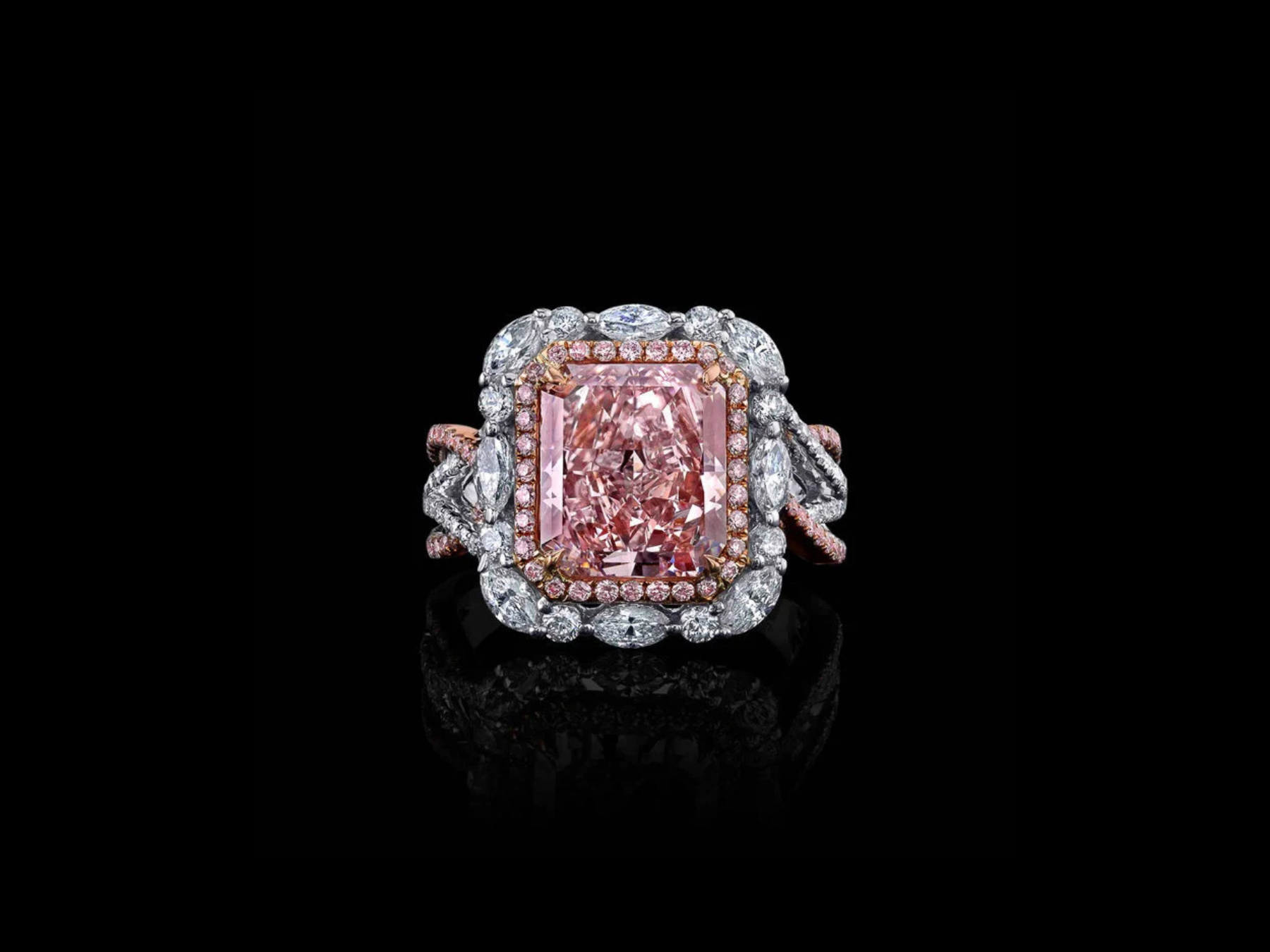
When we talk about the world’s most expensive diamond ring, the numbers are jaw-dropping.
Some of these rings have sold for more than 70 million US dollars, and that is not just because they shine beautifully.
Their value comes from a combination of science, rarity, and craftsmanship that goes far beyond appearance.
Let’s explore how such a diamond ring becomes the most expensive in the world and what this means for anyone who loves fine jewellery.
The Pink Star: The Most Expensive Diamond Ring Ever Sold
The most expensive diamond ring ever recorded is known as The Pink Star.
It features a 59.60-carat fancy vivid pink diamond, certified by the Gemological Institute of America (GIA) as Internally Flawless, meaning it has no visible inclusions even under magnification.
It was auctioned by Sotheby’s in Hong Kong in 2017 and sold for 71.2 million US dollars, purchased by Chow Tai Fook, a luxury jewellery company.
Why it is so valuable
-
Color: “Fancy Vivid Pink” is the highest grade of pink color in diamonds, extremely rare in nature.
-
Clarity: Internally Flawless diamonds of this size are almost impossible to find.
- Carat: 59.60 carats make it one of the largest gem-quality pink diamonds ever discovered.
- Cut: Expertly cut into an oval mixed shape to maximize light reflection and color depth.
- Origin: Mined in South Africa in 1999 by De Beers, the stone took over two years to cut and polish.
This ring’s value is not random. It is the result of geological rarity, human expertise, and flawless execution.
How Experts Evaluate a Diamond’s Worth
The jewellery industry uses the Four Cs system to evaluate any diamond: Cut, Color, Clarity, and Carat. But for rare diamonds like the Pink Star, other hidden factors matter too.
A. Color
- Color is the single most powerful factor in fancy diamonds.
- The more intense and even the color, the higher the value.
- “Fancy Vivid” is the top grade, followed by “Fancy Intense” and “Fancy Light.”
Pink, blue, and red diamonds are the rarest in the world because their colors are formed by unique atomic changes inside the carbon structure, not by artificial treatment or coatings.
B. Clarity
- Clarity shows how clean a diamond is.
- Even a tiny inclusion can reduce the brilliance or durability of a stone.
- Internally Flawless (IF) and Flawless (FL) grades are the rarest and most sought after.
C. Carat
- Carat refers to weight, but bigger is not always better.
- Two diamonds of the same carat weight can have very different prices depending on their color and clarity.
- For rare colored diamonds, value increases sharply with size, not gradually.
D. Cut
- The cut decides how much light the diamond reflects.
- A master cutter can make an average diamond look extraordinary by shaping and angling each facet perfectly.
- The Pink Star’s oval cut enhances both its color saturation and brilliance, making it visually outstanding.
Other Diamonds That Made History
Apart from The Pink Star, several other historic diamonds have reached record prices.
| Diamond Name | Carat Weight | Color | Sold Price (USD) | Auction House |
|---|---|---|---|---|
| The Oppenheimer Blue | 14.62 | Fancy Vivid Blue | 57.5 million | Christie’s (2016) |
| The Graff Pink | 24.78 | Fancy Intense Pink | 46 million | Sotheby’s (2010) |
| The Blue Moon of Josephine | 12.03 | Fancy Vivid Blue | 48.5 million | Sotheby’s (2015) |
| The Winston Pink Legacy | 18.96 | Fancy Vivid Pink | 50 million | Christie’s (2018) |
These diamonds are rare because their colors were created by nature through pressure and time, something that cannot be reproduced by any technology.
The Real Science Behind the Price
- When a diamond crosses the million-dollar mark, science plays a bigger role than glamour.
- Gemologists study the atomic structure, light dispersion, fluorescence, and purity of each stone.
- In ultra-high-value rings, even the smallest detail, such as a microscopic feather or internal reflection, can affect millions in value.
- Certain colors are created due to trace elements.
For example, nitrogen gives a yellow tint, boron produces blue, and structural distortion under extreme pressure results in pink or red hues.
These tiny natural differences make every rare diamond completely unique.
What Regular Buyers Can Learn
You may not plan to buy a million-dollar diamond, but understanding what makes a diamond valuable helps you choose better.
When buying a diamond:
-
Always choose a certified diamond from a trusted lab like IGI or GIA.
-
Prioritize cut and clarity, not just carat.
-
Learn about the origin and ensure it is ethically sourced.
-
Remember, lab-grown diamonds follow the same grading system and offer the same brilliance at a better value.
A smaller, well-cut stone often shines brighter than a larger one with lower quality.
The Future of Diamond Value
The diamond industry is changing.
While natural fancy-colored diamonds remain rare and valuable, lab-grown diamonds are now offering the same sparkle with better ethics and sustainability.
Even luxury brands are adopting lab-grown diamonds for their fine jewellery collections because they are traceable and environmentally responsible.
In the coming years, both rarity and innovation will define luxury. The future belongs to diamonds that combine beauty, responsibility, and craftsmanship.
Final Thought
The world’s most expensive diamond ring is not only about money. It represents mastery, precision, and the natural beauty that takes billions of years to form.
From deep inside the earth to the hands of expert cutters, every stage adds meaning that goes beyond price.
Diamonds like The Pink Star remind us that true luxury lies in perfection and in the human ability to shape nature’s rarest treasures into something timeless
Share:
Are Lab Grown Diamonds Real Diamonds? Let’s Understand Beyond the Hype
Top 10 World's most Expensive Diamond Ring