

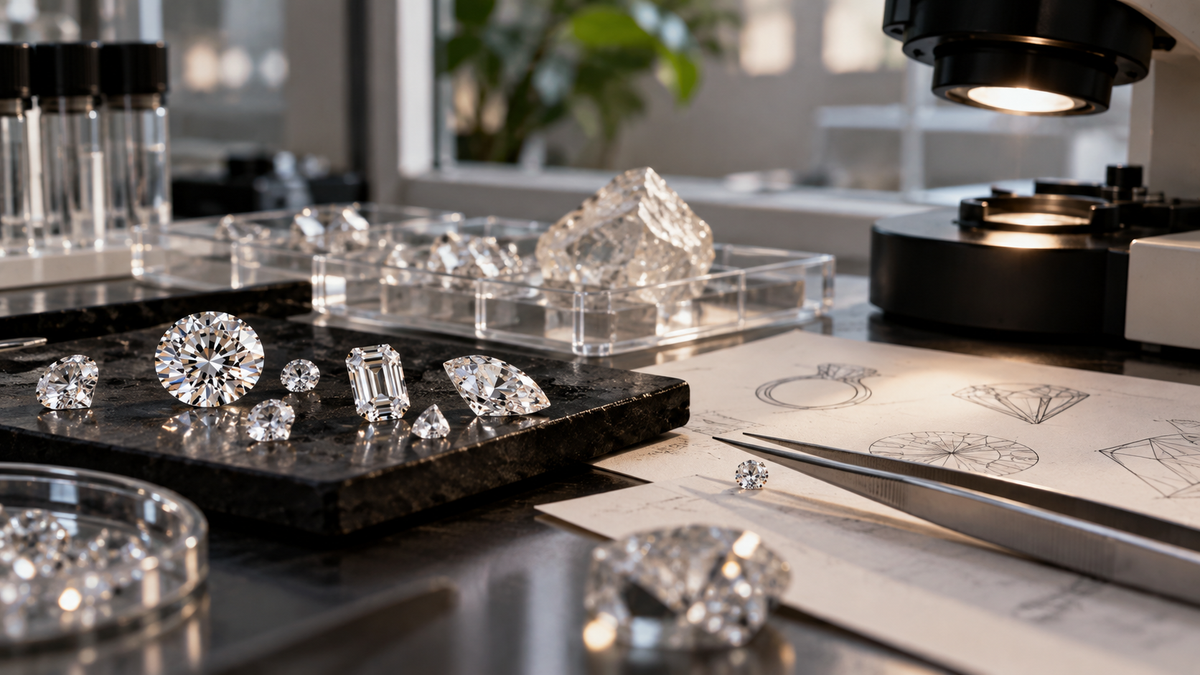
Between Instagram reels explaining CVD diamonds, friends saying “Just get lab-grown, you'll get a much bigger stone”, and jewellers showing you diamonds with different certificates, buying a lab-grown diamond can feel surprisingly complicated.
Especially when the basic question is still sitting there: “Wait… is it actually a diamond?”
The answer to that is Yes. But that's only the beginning of what you need to know.
A lab-grown diamond has the same essential chemical composition and crystal structure as a natural diamond. The difference is where and how it formed: one develops naturally within the Earth, while the other is grown using technology in a controlled environment.
From CVD and HPHT to the Four Cs, diamond shapes, certification, pricing and the details that can make two seemingly identical stones look completely different, we'll take it one decision at a time.
No science lecture! No “bigger is automatically better” logic. No paying extra for a grade you can't actually see. Just a clear way to understand what you're buying and choose a lab-grown diamond with confidence.
Understanding Lab-Grown Diamonds
What Is a Lab-Grown Diamond?
A lab grown diamond is a diamond created in a controlled laboratory environment rather than formed naturally underground.
The important distinction is that it is not a diamond alternative.
A lab-grown diamond has essentially the same chemical composition, crystal structure and optical and physical characteristics as a natural diamond. Gemological laboratories use specialised testing to distinguish laboratory-grown diamonds from natural ones because their properties are so similar.
Think of it this way: A natural diamond and a lab-grown diamond have different origin stories, not a different identity as a diamond.
That distinction is useful because you will often see lab-grown diamonds discussed alongside simulants such as cubic zirconia or moissanite.
Those are different categories. A lab-grown diamond is a diamond. A simulant is a different material that is made to look like one.
Are Lab-Grown Diamonds Real Diamonds?
Yes. This is probably the first thing you should get clear on before comparing prices.
Lab-grown diamonds are not imitation diamonds. They are diamonds produced through controlled growth processes, primarily HPHT (High Pressure High Temperature) and CVD (Chemical Vapour Deposition).
The fact that a diamond was grown in a laboratory does not make it less of a diamond.
What it does change is its origin, and that origin may matter to you for reasons of personal preference, budget or the story you want the ring to represent.
What Makes a Diamond Lab Grown?
The two main growth methods are HPHT and CVD.
HPHT recreates conditions of extremely high pressure and temperature to encourage diamond growth.
CVD uses a controlled chamber in which carbon-containing gases are broken down, and carbon atoms gradually deposit onto a diamond seed.
You don't need to understand the machinery to buy a good diamond. What matters more is understanding that the growth method is not a substitute for diamond quality. A CVD diamond isn't automatically better than an HPHT diamond, and vice versa. You still need to assess the finished stone.
How Lab-Grown Diamonds Are Made
What Is an HPHT Diamond?
HPHT stands for High Pressure High Temperature. The process uses high pressure and high temperature to create conditions that allow diamond material to grow around a small diamond seed.
The method is closely related to the conditions under which natural diamonds form, although the laboratory process is controlled and accelerated. Some HPHT-grown diamonds can contain characteristic inclusions or growth features associated with the process.
The important point for a buyer is simple: HPHT describes how the diamond was grown. It does not tell you whether the finished diamond is beautiful.
You still need to look at cut, proportions, clarity, colour and the actual appearance of the stone.
What Is a CVD Diamond?
CVD stands for Chemical Vapour Deposition. Instead of relying on extreme pressure, CVD uses a controlled environment containing carbon-bearing gases. Carbon atoms are deposited onto a diamond seed, allowing the crystal to grow layer by layer.
CVD is now widely used for producing gem-quality laboratory-grown diamonds. Like HPHT, CVD can produce diamonds with excellent optical performance.
Again, the process is part of the diamond's story, not a shortcut to deciding whether the diamond itself is good.
What Is the Difference Between HPHT and CVD?
The simplest difference is the growth process.
HPHT uses high pressure and high temperature.
CVD grows diamond from a carbon-containing gas in a controlled chamber.
For a buyer, the bigger question is what happened after the growth process and what the finished diamond looks like. Laboratories can identify the growth method using specialised testing, and some grading reports disclose whether a laboratory-grown diamond was produced using CVD or HPHT. So don't let “CVD” or “HPHT” become another version of the Four Cs. It isn't.
What Are Post-Growth Treatments?
Some lab-grown diamonds can undergo treatments after growth to modify or improve their appearance, including colour.
That doesn't automatically mean the diamond is unsuitable. It means the treatment should be understood and properly disclosed.
This is one reason a grading report matters. Depending on the laboratory and report type, treatment information may be included in the documentation.
What to check: If a seller mentions that a diamond has been treated, ask what the treatment was and whether it is disclosed on the grading report.
Lab-Grown vs Natural Diamonds
What Is Actually Different?
The biggest difference is origin.
Natural diamonds formed through geological processes within the Earth.
Lab-grown diamonds are produced using controlled technological processes.
Both are diamonds, but they do not have the same geological history. That distinction matters to some buyers a lot and to others very little. There isn't a correct emotional answer here.
If the idea of a diamond having formed naturally over geological time is important to you, that is part of your buying decision. If you care more about the finished diamond, design and budget, lab-grown may fit your priorities differently.
How Do Lab-Grown and Natural Diamonds Look, Perform and Wear?
To the naked eye, a well-cut lab-grown diamond can look the same as a well-cut natural diamond.
They also share the fundamental hardness and durability associated with diamonds.
So choosing lab-grown doesn't mean accepting less shine or a less durable stone.
What you shouldn't assume is that every lab-grown diamond will look identical. Just as with natural diamonds, cut quality, proportions, clarity, colour and shape influence the finished appearance.
A poorly proportioned lab-grown diamond can look less lively than a beautifully cut natural diamond and vice versa.
What About Origin, Rarity and Personal Choice?
Natural diamonds have a geological origin and finite natural formation history.
Lab-grown diamonds have a manufactured origin and can be produced in controlled environments. That difference contributes to the way the two categories are priced and perceived. But don't let the conversation become “Which one is better?”
A more useful question is: What matters most to you in the diamond you're buying?
Origin? Budget? Size? Design? Personal meaning?
Once you know that, the choice becomes much easier to navigate.
The Four Cs of Lab-Grown Diamonds
Lab-grown diamonds are evaluated using the familiar diamond quality framework of Cut, Colour, Clarity and Carat, although the exact format and terminology used can vary by grading laboratory and report type. IGI, for example, provides 4Cs assessments on its laboratory-grown diamond reports.
The important thing is not to treat the Four Cs like four scores you simply maximise. They're four different ways of describing the diamond.
Cut is about how the diamond's proportions and facets interact with light. It has a huge influence on how lively the diamond looks. A larger lab-grown diamond with mediocre light performance can be less impressive than a smaller one with excellent proportions. So if shine matters to you, don't let carat become the first and only number you compare.
Colour describes how much visible body colour a diamond has. The familiar D-to-Z scale moves from the top end of colourlessness towards increasingly noticeable warmth. But colour is contextual. The same diamond can look different depending on its shape, size, lighting and metal setting. A little warmth can also be part of the look you prefer.
Clarity describes inclusions inside the diamond and blemishes on its surface. The practical question is not simply “What's the highest clarity I can afford?” It's: Can I see anything that bothers me? If a diamond is eye-clean, paying considerably more for a higher clarity grade may not create a visible improvement.
This is particularly important when comparing lab-grown diamonds because the larger sizes available within a given budget can make clarity differences more noticeable.
Carat measures weight. It does not directly measure visual size. A one-carat oval can occupy more visible area than a one-carat round. A deeper diamond can carry weight below the surface without looking proportionally larger from above. So if you're choosing a lab-grown diamond partly because you want more visual size for your budget, look at millimetre measurements, not just carat.
You don't necessarily want the highest grade in every category. You may prefer a slightly lower colour grade because you're setting the diamond in yellow gold. You may choose a lower clarity grade because the stone is eye-clean. You may prioritise cut because shine matters most to you. Or you may decide visual size is the priority and look for a shape and set of proportions that gives you more face-up coverage.
The goal is not to win at the Four Cs. The goal is to balance them around what you can actually see and what you actually care about.
Lab-Grown Diamond Shapes Explained
Round brilliant remains the classic choice because its faceting is designed for strong light return. If you want the familiar bright, lively diamond look, it is an easy starting point. It also works with almost every engagement-ring setting.
Oval gives you an elongated outline with brilliant-style shine. One of its biggest attractions is visual coverage: it can look larger across the finger than a round of similar weight. But always look for the bow-tie, a darker area that can appear across the centre of elongated brilliant cuts. Some bow-tie is normal. What matters is whether it is distracting.
Emerald cuts are all about broad flashes rather than intense pin-point shine. Their long step facets create a clean, reflective appearance. Because those facets are relatively open, clarity can be especially important. If you like understated, architectural jewelry rather than maximum shine, emerald is worth serious consideration.
Cushion offers softer corners and can range from square to elongated.
Pear combines a rounded end with a pointed tip, making protection around the point important.
Marquise gives significant length and finger coverage, but symmetry matters.
Princess has crisp, geometric corners and a distinctly modern feel.
Radiant combines a structured outline with brilliant-style faceting.
Asscher uses deep step-cut facets for a geometric, hall-of-mirrors effect.
Heart is immediately recognisable, but symmetry between the lobes and point is especially important.
The same rule applies to all of them: Don't compare shapes by carat alone. Compare how much diamond you actually see from the top.
What Different Lab-Grown Diamond Shapes Can Reflect
Diamond shape is often described using personality associations: round is classic, oval is elegant, emerald is sophisticated, cushion is romantic, and so on.
Treat those descriptions as style inspiration rather than fact. What shape genuinely changes is the visual character of the ring.
If their jewelry is clean and understated, an emerald or refined oval may feel natural. If they like shine and classic silhouettes, round may make more sense.
If they prefer unusual details, an East-West radiant, marquise or Toi et Moi design can create something less expected.
The best shape isn't the one with the most flattering description online. It's the one that makes you think: “Yes. That looks like them.”
Lab-Grown Diamond Cut, shine and Proportions
What Is the Difference Between Shape and Cut?
Shape is the outline.
Cut is about how the diamond has been proportioned and faceted.
An oval is a shape. Its cut determines how effectively that oval interacts with light. This distinction matters because you can have two lab-grown ovals with the same carat, colour and clarity grades that look noticeably different.
What Are Brilliant, Step and Modified Brilliant Cuts?
Brilliant cuts are designed around strong light return and lots of active radiance.
Step cuts use long, parallel facets that create broader flashes and reflections.
Modified brilliant cuts adapt brilliant faceting to different shapes.
The result is a different visual language. If you want energetic shine, brilliant styles are a natural place to look.
If you prefer clean reflections and symmetry, step cuts may appeal more.
What Makes a Lab-Grown Diamond shine?
Three terms explain most of what you're seeing:
Brilliance is white light reflected back.
Fire is the coloured light you see when the diamond disperses light.
Scintillation is the pattern of flashes you notice as the stone or your hand moves.
Good shine is about more than having a high grade on paper.
It comes from the relationship between the facets and proportions.
Why Can Two Lab-Grown Diamonds Look Different?
Because same carat does not mean same diamond.
Two stones can have similar headline specifications and still differ in:
-
Millimetre dimensions
-
Proportions
-
Facet arrangement
-
Symmetry
-
Light return
-
Clarity characteristics
-
Shape
This is why an expert comparison should involve looking at the actual diamonds, not simply comparing two specification sheets.
Lab-Grown Diamond Size and Technical Details
Carat Weight vs Visual Size
If you want the diamond to look large on the finger, ask for its measurements. A stone with more face-up area can look larger than a heavier stone with deeper proportions.
This is one of the reasons elongated shapes are popular among buyers who want visual coverage. But don't chase millimetres blindly either. A diamond can be spread too far to achieve face-up size at the expense of light performance. Size and proportions have to work together.
What Are Measurements, Depth, Table and Length-to-Width Ratio?
Measurements tell you the diamond's length, width and depth in millimetres.
Depth tells you how far the diamond extends from top to bottom.
Table is the large facet on the top.
Length-to-width ratio tells you how elongated the diamond is.
These numbers are particularly useful when comparing fancy shapes.
An oval with a ratio of 1.30 will look noticeably different from an oval at 1.50, even if both weigh one carat.
There is no universal perfect ratio. The right one depends on the shape and the look you prefer.
What Are Symmetry, Polish and Fluorescence?
Symmetry refers to how accurately the diamond's facets and overall outline align.
Polish describes the quality of the diamond's finished surface.
Fluorescence is the diamond's reaction to ultraviolet light.
These details should be considered as part of the whole stone rather than treated as automatic pass/fail criteria.
What Are Growth Features and Inclusions?
Lab-grown diamonds can contain internal features associated with their growth process.
Depending on the growth method, these can differ from the inclusions commonly seen in natural diamonds.
Some features may only be visible under magnification. Others can affect the stone's appearance.
This is why clarity grading and professional examination matter.
What to check: If you're considering a larger stone, ask to see the diamond magnified as well as face-up. You want to understand what is actually inside the stone, not just its clarity grade.
Lab-Grown Diamond Certification and Grading
What Does a Lab-Grown Diamond Certificate Tell You?
A grading report is essentially the diamond's documented specification sheet.
Depending on the laboratory and report type, it can identify the stone as laboratory-grown and provide information such as shape, measurements, colour, clarity, carat weight, proportions and other characteristics.
But here's an important distinction: A grading report is not the same thing as a guarantee that you'll love the diamond. It tells you what the laboratory found. Your eyes still need to decide whether you like the stone.
What About GIA, IGI and Other Grading Reports?
GIA and IGI are among the recognised gemological laboratories that provide laboratory-grown diamond identification and assessment services.
The exact format of their reports can differ.
For example, IGI's laboratory-grown diamond report provides 4Cs assessments, while GIA's current laboratory-grown services use a distinct quality-assessment format for certain lab-grown diamonds.
That means you should not assume that every laboratory report will look identical or use exactly the same terminology. Read the report you're actually being given.
How Do You Verify a Diamond Report?
Don't stop at seeing a PDF. Use the grading laboratory's own report-verification system where available and check that the report number, diamond description and specifications correspond to the stone you're buying.
If the diamond has a laser inscription on its girdle, the inscription can provide another way to connect the physical stone to its report. GIA and IGI both describe laser-inscription systems for laboratory-grown diamonds.
What Is a Laser Inscription?
A laser inscription is a microscopic marking placed on the diamond's girdle.
It can contain a report number and, depending on the laboratory, an identification such as “Laboratory-Grown”. It isn't something you normally see while wearing the diamond.
It's there primarily for identification and verification.
The simple rule: The report should belong to the diamond, not simply be a report for a similar-looking stone.
How Much Do Lab-Grown Diamonds Cost?
What Determines the Price?
The price of a lab-grown diamond depends on more than carat.
Factors can include:
-
Carat weight
-
Shape
-
Cut and proportions
-
Colour
-
Clarity
-
Measurements
-
Growth characteristics
-
Treatments
-
Grading report
-
Market pricing
-
The jeweller's setting and craftsmanship
This is why saying “It's a two-carat lab-grown” doesn't tell you enough to compare it with another two-carat stone.
Why Can Two Similar Lab-Grown Diamonds Have Different Prices?
Because “similar” isn't the same as “identical”.
Two two-carat diamonds may have different shapes, measurements, colour, clarity, cut quality and reports. Even when the visible difference seems small, those specifications can affect pricing.
So if one jeweller quotes significantly less, don't immediately assume you've found the better deal.
Ask: What exactly is different between the two diamonds?
What About Diamond, Setting, Gold, Making Charges and GST?
When buying a finished ring, you're paying for more than the diamond.
The final price may include:
Diamond + metal + setting + craftsmanship/making charges + certification + applicable GST.
Ask for the breakdown. This is particularly useful when comparing rings from different jewellers because one quote may include certain charges differently from another.
How Do You Compare Lab-Grown Diamond Prices?
Compare like with like. Put the specifications side by side.
Look at:
-
Shape
-
Carat
-
Measurements
-
Colour
-
Clarity
-
Cut information
-
Certificate
-
Growth method, where disclosed
-
Treatment disclosure
-
Final jewelry price
Then look at the actual diamonds. The cheapest stone isn't automatically the best value. The most expensive isn't automatically the best quality.
Value comes from the combination of what you're getting and what you actually care about.
Choosing a Lab-Grown Diamond for an Engagement Ring
Should You Choose the Diamond Before the Ring?
Usually, understanding the diamond first makes the design process easier.
Once you know the shape, size and visual character you're drawn to, the setting becomes a design decision rather than a guessing game.
For example, an oval may work beautifully in a solitaire, halo or East-West setting but each creates a completely different ring.
How Should You Match the Diamond to the Setting?
Think of the diamond and setting as one composition.
A delicate band can make a centre stone look more prominent.
A halo can increase visual impact.
A bezel can make the design feel cleaner and more protective.
A cathedral setting can lift the centre stone and create room for a wedding band.
The setting should support the diamond rather than compete with it.
How Should Lifestyle Affect Your Choice?
If the ring will be worn every day, think beyond the proposal photograph.
Someone who works with their hands may prefer a lower or more protective setting.
Someone who loves jewelry and doesn't mind regular maintenance may happily choose intricate pavé.
Someone who travels frequently may appreciate a design with fewer exposed details.
The best ring is not just beautiful. It is beautiful in the context of the life it is going into.
Custom vs Ready-Made
Ready-made rings make sense when you find a design you genuinely love.
Custom design becomes useful when you want specific proportions, a particular setting or details that aren't readily available.
With a custom ring, ask for the diamond specifications, final dimensions, metal purity, timeline, resizing terms and what happens if the final result differs from the agreed design.
The value of good custom design isn't simply getting something “unique”. It's having someone who understands jewelry help turn several preferences into one coherent ring.
Choosing the Right Metal and Setting
Yellow Gold, White Gold, Rose Gold or Platinum?
The metal changes the entire mood of the ring.
Yellow gold adds warmth and a classic feel.
White gold creates a bright, contemporary appearance.
Rose gold brings a softer pink tone.
Platinum has a naturally white appearance and is known for its durability.
If you're buying for someone else, their existing jewelry is usually your safest clue.
What Are Prong, Bezel, Halo and Other Settings?
Prongs hold the diamond with small metal claws, allowing plenty of the stone to remain visible.
Bezel settings surround the stone with a metal rim, offering greater protection.
Halo settings surround the centre stone with smaller diamonds to increase sparkle and visual presence.
Pavé settings place small diamonds closely along the band.
Cathedral settings raise the centre stone using supporting shoulders.
The right setting depends on the look you want and how the ring will be worn.
Security vs Diamond Visibility
This is one of the practical trade-offs buyers often overlook.
A more exposed diamond can create an open, high-impact look. A more enclosed setting can offer greater protection. Neither is automatically better.
Ask what matters more for the wearer: maximum visibility, maximum protection or a balance of both?
Buying a Lab-Grown Diamond
What Should You Check Before Buying?
Before paying, you should know:
-
Is it definitely a lab-grown diamond?
-
What is the grading laboratory?
-
Does the report match the physical diamond?
-
What are the carat weight and measurements?
-
What are the colour and clarity grades?
-
What cut information is available?
-
What is the shape?
-
Is the growth method disclosed?
-
Are treatments disclosed?
-
Is there a laser inscription?
-
What metal is the ring made from?
-
What is the final price?
-
What are the resizing, return and warranty policies?
You don't need to memorise all of this.
Ask the jeweller to walk you through it.
A good jeweller should make the information easier to understand, not make you feel silly for asking.
What Should You Know About Buying Online?
Buying online can make comparison easier because specifications are often displayed side by side.
But a lab-grown diamond is still a physical object. Pay attention to whether the listing gives you enough information to assess the actual stone.
Look for clear measurements, grading information, report numbers, photographs or videos and transparent return policies. If you're comparing two diamonds online, don't compare only the thumbnail. Compare the specification and the stone.
What Should You Know About Certification, Returns, Resizing and Warranty?
These are not boring terms to read after you've paid. They're part of the purchase.
Check:
Can the ring be resized?
Is there a return window?
What does the warranty cover?
What happens if a stone becomes loose?
Does the certificate correspond to the exact centre diamond?
And if the ring is custom-made, understand the cancellation and alteration terms before the design is approved.
What Questions Should You Ask Your Jeweller?
If you want to keep it simple, ask these:
What exactly am I paying for?
Can I see the grading report?
Can I verify the report number myself?
What are the diamond's measurements?
Why did you choose this stone over the other one?
Are there any treatments?
What is the resizing policy?
What happens if I have an issue after purchase?
The quality of the answers tells you a lot about the buying experience you're getting.
Common Lab-Grown Diamond Buying Mistakes
Choosing Carat Before Understanding the Diamond
A two-carat diamond sounds impressive. But carat is only weight. If you want a diamond that looks large, compare measurements and face-up size. If you want sparkle, examine cut and proportions. Don't let the biggest number make the decision for you.
Assuming the Highest Grade Is Always Better
A higher grade is not automatically a better purchase for your particular priorities.
If you cannot see the difference between two clarity grades, why make clarity the place where your entire budget goes?
The same applies to colour. Spend where the difference is visible and meaningful to you.
Comparing Only Price
₹X for one diamond and ₹Y for another tells you almost nothing without the specifications.
Compare the diamonds first. Then compare the prices.
Ignoring Proportions and Visual Appearance
This is especially easy to do online. A diamond can have an impressive certificate and still not have the face-up appearance you want. Look at measurements, shape, proportions and actual light performance.
Confusing a Grading Report With an Appraisal
A grading report documents characteristics assessed by a gemological laboratory.
An appraisal is a valuation for a particular purpose, such as insurance. They are not the same thing. The report helps you understand what the diamond is. An appraisal addresses what it may be valued at for a particular purpose.
Caring for a Lab-Grown Diamond
How Should You Clean and Wear It?
Lab-grown diamonds have the same fundamental durability associated with diamond, but the jewelry they're set into still needs care.
Remove the ring when you're doing activities involving heavy impact, harsh chemicals or unnecessary abrasion. For routine cleaning, use an appropriate jewelry-cleaning method for the diamond and metal.
What About Inspection, Repairs and Resizing?
The diamond may be extremely durable, but the setting isn't indestructible. Prongs can wear. Small stones can loosen. Bands can scratch or deform.
A periodic professional inspection can catch these issues before they become expensive repairs.
If you notice a loose stone, damaged prong or sudden change in the ring's shape, get it checked rather than continuing to wear it and hoping for the best.
Lab-Grown Diamond Buying Checklist
Before you buy, make sure you can answer:
About the diamond
-
Is it a genuine lab-grown diamond?
-
Do I know whether it was grown using CVD or HPHT, if disclosed?
-
Have I seen the actual stone?
-
Do I understand its shape and cut?
-
Have I checked its measurements?
-
Do I understand its colour and clarity?
-
Is it eye-clean?
-
Does the diamond look lively in motion?
About the report
-
Which laboratory graded or assessed it?
-
Does the report number match the stone?
-
Can I verify the report online?
-
Is there a laser inscription?
-
Are treatments disclosed?
About the ring
-
Does the setting suit the diamond?
-
Is it secure enough for everyday wear?
-
Does the metal suit the wearer?
-
Will it work with a wedding band?
-
Is the ring size correct?
About the price
-
What is the diamond price?
-
What is the metal cost?
-
What are the making charges?
-
Is certification included?
-
What GST applies?
-
What is the final amount?
About after-sales
-
Can it be resized?
-
What is the return policy?
-
What does the warranty cover?
-
Is inspection or cleaning included?
-
Who do I contact if something goes wrong?
If you can answer those questions, you're no longer buying simply because someone told you that lab-grown gives you “more diamond for your money”.
You're choosing a diamond because you understand what you're getting.
Lab-Grown Diamond FAQs
Is a lab-grown diamond a real diamond?
Yes. Lab-grown diamonds have essentially the same chemical composition and crystal structure as natural diamonds. The difference is their origin and method of formation.
Are lab-grown diamonds as durable as natural diamonds?
Diamond is extremely hard, and lab-grown diamonds share the fundamental properties of diamond. However, the durability of the finished jewelry also depends on the setting, metal and construction.
Is CVD better than HPHT?
Neither method is automatically better. CVD and HPHT describe how the diamond was grown. The finished diamond still needs to be judged on its individual characteristics, including proportions, cut, colour, clarity and appearance.
What is the difference between CVD and HPHT?
CVD uses a controlled gas-based process to grow diamond on a seed, while HPHT uses high pressure and high temperature. Gemological laboratories can identify growth methods using specialised testing.
Do lab-grown diamonds have inclusions?
They can. Lab-grown diamonds can contain internal features associated with their growth process. Their presence and visibility depend on the individual stone and are reflected, where applicable, in clarity assessment.
Are lab-grown diamonds graded using the Four Cs?
Many laboratory-grown diamond reports use the familiar Four Cs framework. IGI's lab-grown reports, for example, provide assessments for carat, colour, clarity and cut. Report formats can differ between laboratories, so check the specific report you're being given.
Does every lab-grown diamond come with a certificate?
Not necessarily in the same form. The important thing is to understand what documentation is provided, who issued it and whether you can independently verify it.
How do I know the certificate belongs to my diamond?
Check the report number against the grading laboratory's verification system and, where applicable, compare the laser inscription on the diamond with the report.
Are lab-grown diamonds cheaper than natural diamonds?
They are generally priced differently from natural diamonds, but the exact price depends on the individual diamond and market conditions. Don't assume that every lab-grown diamond should have the same price per carat.
Why are two two-carat lab-grown diamonds priced differently?
Because carat is only one characteristic. Shape, cut, proportions, colour, clarity, measurements, certification, treatments and other factors can all affect the price.
Do lab-grown diamonds lose value?
Don't treat the original purchase price as a guaranteed future resale value. The market for lab-grown diamonds is different from the original retail purchase, and future value can depend on market conditions, product characteristics and the buyer. If long-term financial value is important to you, discuss that separately from the question of which diamond looks best.
Should I choose lab-grown or natural?
Start with what matters to you. If origin and geological rarity are central to the meaning of your purchase, natural may align more closely with those priorities. If you care more about the finished diamond, design, size and budget, lab-grown may offer a different set of trade-offs. There isn't a universal answer.
Is a lab-grown diamond a good choice for an engagement ring?
It can be. The important question isn't simply whether it is lab-grown. It is whether the individual diamond is well chosen, the setting is suitable, the price is transparent and the ring is something the person wearing it will genuinely love. And that's really the point of all this information. You don't need to walk into a jewelry store knowing every diamond term.
You just need enough knowledge to ask better questions, recognise a good explanation and understand what you're actually paying for. Once you can do that, choosing a lab-grown diamond becomes much less about “Is lab-grown the right thing to buy?” And much more about the question that actually matters: “Is this the right diamond for us?”
Share:
How Long Do Lab-Grown Diamonds Last?