

Is VVS Worth the Extra Money, or Is VS1 Good Enough?
VVS diamonds command a higher price because they contain fewer inclusions and are rarer than VS1 diamonds. But a higher clarity grade doesn't automatically make it the better choice for every buyer. In many cases, the difference between a VS1 and a VVS diamond isn't something you'll notice without magnification, while the price difference can be significant.
That's why the better question isn't "Which clarity grade is better?" It's "What am I getting for the extra money?" For some buyers, paying more for VVS is worth it because they want the highest possible clarity or simply value rarity. For others, a VS1 diamond delivers the same visual beauty while leaving room in the budget for a larger carat weight, a superior cut, or a more intricate setting.
This guide compares VS1 and VVS diamonds in simple terms, helping you understand the real differences in clarity, appearance, and value so you can decide which option is right for you.
Can You Actually See the Difference Between VS1 and VVS?
In most everyday situations, probably not.
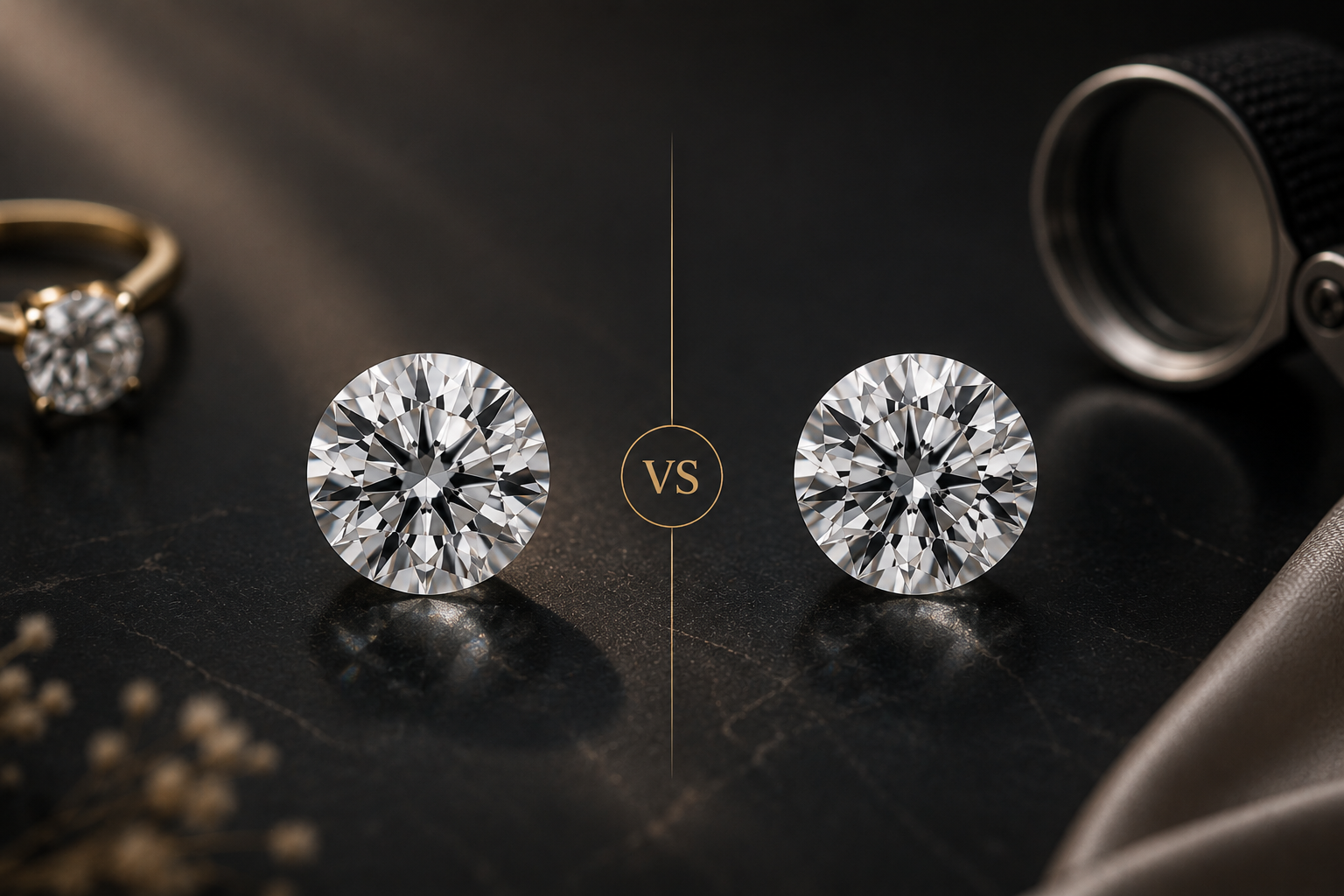
When a diamond is set in a ring, pendant, or pair of earrings and viewed from a normal distance, both VS1 and VVS diamonds typically appear flawless to the naked eye. That's because the inclusions in both clarity grades are extremely small and usually invisible without magnification.
The difference becomes noticeable mainly during professional inspection. Gemologists use a 10x magnification loupe, the industry standard for grading diamonds, to locate and evaluate inclusions. Under this magnification, a VVS diamond has fewer and smaller inclusions than a VS1 diamond, which is why it receives a higher clarity grade.
However, visibility also depends on factors such as the size of the diamond, the type and location of the inclusions, and your viewing conditions. For example, inclusions are generally easier to spot in a larger 3-carat diamond than in a smaller 1-carat diamond. Likewise, an inclusion positioned near the centre of the diamond is more noticeable than one hidden close to the edge or beneath a prong.
For most engagement rings and everyday jewellery, a well-selected VS1 diamond is considered eye-clean, meaning you won't see its inclusions without magnification. This is why many buyers compare more than just the clarity grade. They also consider factors like cut quality, carat weight, and the overall appearance of the diamond before making a decision.
Fact: The Gemological Institute of America (GIA) defines a VVS diamond as having inclusions that are extremely difficult for a skilled grader to see under 10x magnification. VS1 inclusions are still difficult to detect under the same conditions, which is why both clarity grades are regarded as high quality.
What's the Real Difference Between VS1 and VVS Diamonds?
Before comparing prices or deciding which clarity grade offers better value, it's important to understand what actually separates VS1 and VVS diamonds.
Both belong to the higher end of the diamond clarity scale and are considered excellent choices for fine jewellery. The main difference lies in the number, size, and visibility of internal inclusions and surface blemishes. VVS diamonds contain extremely tiny inclusions that are exceptionally difficult for a trained grader to see under 10x magnification. VS1 diamonds may have slightly more noticeable inclusions under magnification, but they are still difficult to detect and are often invisible to the naked eye.
In practical terms, both clarity grades can produce stunning diamonds. The difference is primarily one of rarity and grading, rather than everyday appearance.
|
Feature |
VS1 Diamond |
VVS Diamond |
|
Full Form |
Very Slightly Included 1 |
Very Very Slightly Included (VVS1 & VVS2) |
|
Inclusions |
Very small |
Extremely small |
|
Visibility Under 10x Magnification |
Difficult to see |
Extremely difficult to see |
|
Naked Eye Appearance |
Usually eye-clean |
Eye-clean |
|
Rarity |
Rare |
Rarer |
|
Price |
Lower |
Higher |
Key takeaway: For most buyers, the biggest difference between VS1 and VVS isn't how the diamond looks—it's the level of clarity achieved under professional grading and the premium attached to that rarity.
Read More About: VVS Diamonds vs VS Diamonds
Why Does a VVS Diamond Cost More Than a VS1 Diamond?
The higher price of a VVS diamond isn't based on how much more it sparkles. It's primarily a reflection of its rarity and clarity grade.
During the diamond grading process, experts examine every stone under 10x magnification to identify and evaluate internal inclusions and surface blemishes. Since VVS diamonds have exceptionally tiny inclusions that are extremely difficult to detect, they are less common than VS1 diamonds and are therefore priced at a premium.
Another factor is supply. As clarity improves, the number of diamonds that qualify for that grade becomes smaller. Finding a diamond with very few natural characteristics is less common, which naturally increases its value in the market.
However, it's important to understand what that premium represents. In most cases, you're paying for a higher clarity grade and greater rarity, not a dramatic improvement in visible appearance. This is why some buyers choose VVS for its exclusivity, while others prefer a high-quality VS1 diamond and invest the savings in a larger carat weight, an exceptional cut, or a more elaborate setting.
Factors That Influence the Price Difference
|
Factor |
Impact on VVS Price |
|
Rarity |
VVS diamonds are less common than VS1 diamonds. |
|
Clarity Grade |
Higher clarity grades generally command higher prices. |
|
Inclusions |
Smaller and fewer inclusions increase the diamond's value. |
|
Demand |
Premium clarity grades are often preferred by buyers seeking top-quality diamonds. |
When Is Paying Extra for a VVS Diamond Worth It?
A VVS diamond isn't automatically a better buy just because it costs more. Its value depends on what matters most to you.
Paying extra for VVS may be worth considering if:
You Want the Highest Possible Clarity
Some buyers simply want a diamond with exceptionally high clarity, even if the difference isn't visible without magnification. For them, owning a rarer diamond is part of the experience.
You're Buying a Larger Diamond
As a diamond's carat weight increases, its inclusions can become easier to detect under close inspection. While a well-selected VS1 diamond is still eye-clean in many cases, some buyers choosing larger diamonds prefer VVS for added peace of mind.
You Appreciate Rarity
VVS diamonds are less common than VS1 diamonds. If rarity and premium quality are important to you, paying more for a VVS diamond can be a meaningful choice.
You Prefer the Best Available Within Your Budget
If your budget comfortably allows for a VVS diamond without compromising on other important factors such as cut, carat weight, or the setting, choosing the higher clarity grade can be a satisfying long-term decision.
Remember That Clarity Is Just One Part of the Diamond
A diamond's beauty depends on more than its clarity grade. Factors such as cut, proportions, symmetry, polish, and carat weight all influence how the diamond looks. Choosing the right balance between these characteristics often results in a better overall diamond than focusing on clarity alone.
Conclusion
Choosing between a VS1 and a VVS diamond isn't about finding a universally better clarity grade. It's about understanding what you're paying for and deciding which option best matches your priorities.
If you value exceptional rarity and want one of the highest clarity grades available, a VVS diamond is an excellent choice. If your goal is to maximise beauty and overall value without compromising on appearance, a carefully selected VS1 diamond can be equally rewarding.
The best diamond isn't always the one with the highest clarity grade. It's the one that offers the right balance of cut, clarity, carat weight, and craftsmanship within your budget. By considering the complete picture instead of focusing on a single specification, you'll be better equipped to choose a diamond you'll enjoy for years to come.
Share:
Can Anyone Tell if a Diamond Is Lab Grown? Here's What You Need to Know
Should You Prioritize Cut, Carat, Colour or Clarity? What Matters Most