

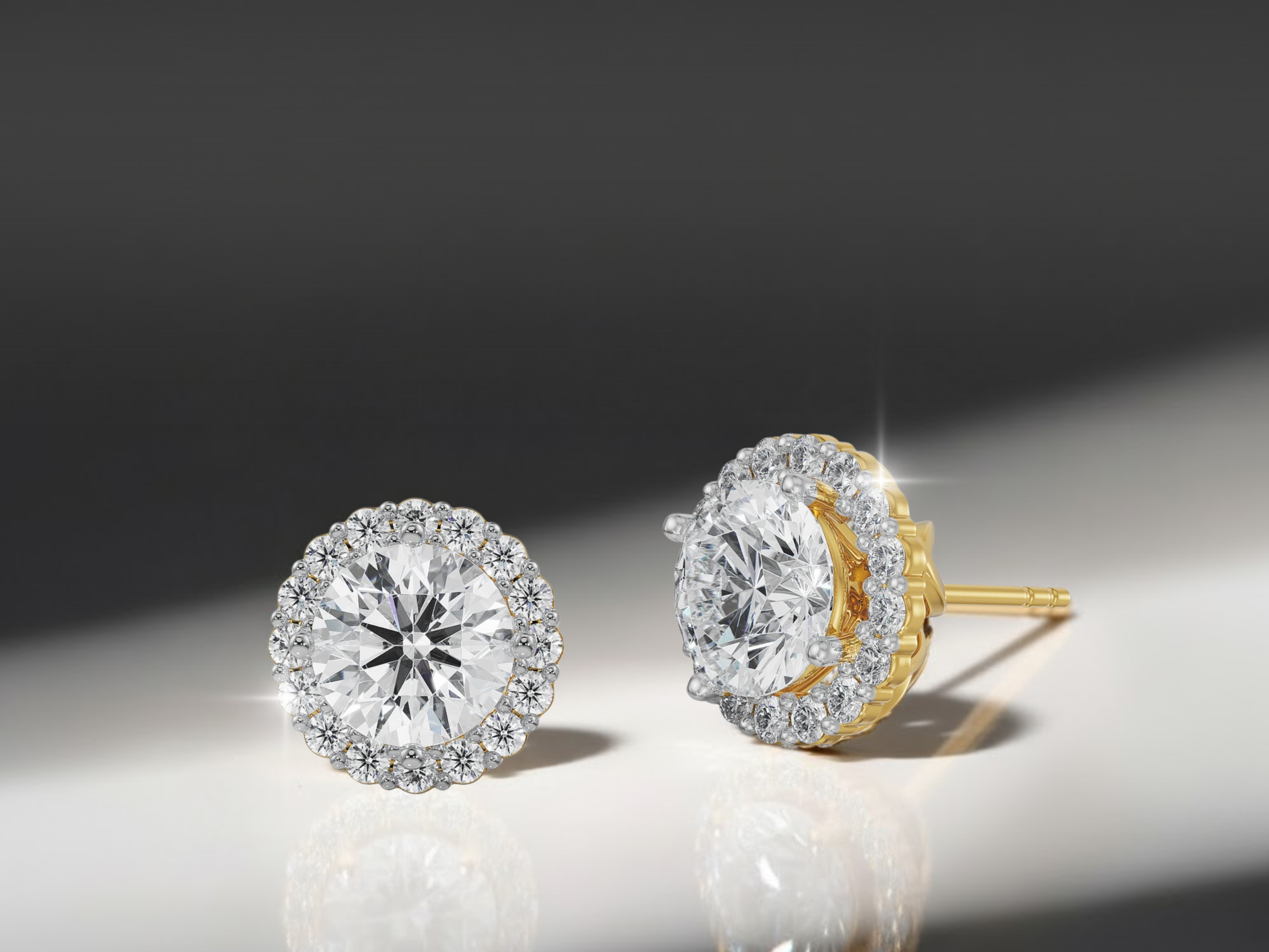
Diamond studs look simple from the outside. But the moment you think about buying a pair, you realise that choosing the right size is more complex than just “big or small.” A diamond stud sits right at the centre of your face. Its size affects your overall appearance, how symmetrical your face looks, how balanced your ears feel, and how comfortable the earrings stay for long hours.
Finding the perfect diamond stud size is a mix of understanding carat weight, millimetre dimensions, your facial proportions, your ear anatomy, and your lifestyle. When you understand these elements, choosing becomes easy and accurate.
This guide explains everything in a practical, detailed way so you can confidently choose the right size, whether you want natural or lab grown diamond studs.
1. Carat Weight vs. Millimetre Size: The Misunderstood Difference
Most people choose studs based on carat weight. But carat is a weight measurement, not a size measurement. Two diamonds with the same carat weight can still look different in size if one is deeper or cut differently.
This is why millimetre size (mm) gives a clearer idea.
Approximate carat-to-mm chart:

- 0.10ct per ear → ~3.0 mm
- 0.25ct per ear → ~4.1 mm
- 0.50ct per ear → ~5.0 mm
- 0.75ct per ear → ~5.8 mm
- 1.00ct per ear → ~6.4 mm
- 1.50ct per ear → ~7.3 mm
- 2.00ct per ear → ~8.1 mm
The millimetre spread decides how large the stud will actually on your ear.
Lab grown diamond studs often use ideal-cut diamonds, so their mm spread is usually excellent for their carat weight.
2. The Science of Visual Balance: How Stud Size Affects Your Face

Your diamond stud size changes how your face looks. Well-sized studs enhance your natural symmetry. Oversized studs can pull attention away from your eyes. Too-small studs may disappear against your features.
A. Face Shape Analysis
Round Face
Needs length and structure.
Best sizes: 0.50–0.75ct per ear (5 to 6 mm).
Oval Face
Most sizes suit you.
Best sizes: 0.30–1.00ct per ear depending on style.
Square Face
Soft edges look best.
Best sizes:0.40–0.60ct per ear for balance.
Heart-Shaped Face
Avoid very large tops.
Best sizes: 0.20–0.50ct per ear.
Long Face
Medium-to-wide spread helps.
Best sizes: 0.60–1.00ct per ear.
3. Ear Lobe Anatomy: The Part Most People Ignore
Ear lobe shape decides how studs sit.
Small or Thin Ear Lobes
-
Larger studs appear too heavy
-
Prong settings may poke
Ideal size: 3.5–5 mm (0.15–0.40ct per ear)
Medium Ear Lobes
Can carry most sizes
Ideal size: 4.5–6 mm (0.25–0.75ct per ear)
Large or Fleshy Ear Lobes
Need broader diamonds for balance
Ideal size: 5.5–7.5 mm (0.60–1.50ct per ear)
If you’re unsure, this is where lab grown diamond solitaire studs help, you can go slightly bigger without crossing your budget.
4. The Optical Effect: Why Some Studs Look Bigger Than Others
Four studs with the same carat can still look different depending on:
Cut Quality
well-cut diamond reflects more light, making it appear bigger.
Depth Percentage
Shallow stones spread wider, deep stones look smaller.
Setting Style
-
Four-prong: looks bigger
-
Three-prong martini: sits deeper, cleaner look
- Bezel: looks smaller but very modern and protective
If you want maximum size appearance without increasing carat weight, choosing a well-cut lab grown diamond studs with a 4-prong setting is a smart choice.
5. Lifestyle and Daily Comfort: Your Routine Matters
Active Lifestyle / Work with Kids / Fitness
Choose smaller-to-medium sizes that do not snag.
Recommended:0.20–0.40ct per ear
Office/Corporate Profession
Moderate sizes look elegant and professional.
0.40–0.60ct per ear
Event / Glam Look / Wedding Wear
Larger sizes make a strong statement.
Recommended: 1.00–2.00ct per ear
(Here, lab grown becomes extremely affordable.)
All-day, Everyday Wear
Comfort is key.
Recommended:4.5–5.5 mm (0.25–0.60ct)
6. Skin Tone and Metal Matching (Important but Overlooked)
Diamond stud visibility increases when the metal colour complements your skin tone.
Warm Skin Tone
Yellow gold or rose gold enhances contrast.
Cool Skin Tone
White gold or platinum enhances brilliance.
Matching metal correctly can make even a smaller diamond appear larger and brighter.
7. Occasion-Based Size Guide
Daily Wear
0.20–0.50ct per ear
(Meets both comfort and style)
Work Wear
0.30–0.60ct per ear
(Professional yet noticeable)
Special Occasions
0.75–1.50ct per ear
(Adds glamour without feeling heavy)
Minimalist Lovers
3–4 mm sizes
(Delicate, subtle, light)
Luxury Lovers
7–8 mm sizes
(A bold and timeless choice)
8. Why Lab Grown Diamond Studs Make Sizing Easier
Lab grown diamonds give you the advantage of going bigger without stretching your budget. Since they match natural diamonds in brilliance and durability, they are ideal when:
- You want a larger diamond size
- You want better cut quality for more sparkle
- You want balanced studs for your facial proportions
- You want lifelong wear at a friendlier price
This is why many buyers choose a lab grown diamond studs when selecting larger sizes like 1ct or above.
9. Final Quick Chart: The Most Practical Sizes
| Look / Lifestyle | Recommended mm size | Carat per ear |
|---|---|---|
| Minimal Daily | 3.5–4.5 mm | 0.15–0.30 ct |
| Balanced Everyday | 4.8–5.5 mm | 0.35–0.60 ct |
| Statement Daily | 5.8–6.4 mm | 0.70–1.00 ct |
| Event Wear | 7.0–8.0 mm | 1.25–2.00 ct |
Final Thoughts
Choosing the perfect diamond stud size is not about guessing. It’s about understanding how carat, millimetre size, face proportions, ear structure, and lifestyle all come together. A well-chosen pair of studs highlights your features, looks balanced on your face, and stays comfortable all day.
Whether you select natural diamonds or go for a lab grown diamond studs, the best size is the one that enhances your face, matches your lifestyle, and makes you feel confident every time you wear it.
Share:
Which Lab Grown Diamond Ring Designs Stay Trendy the Longest?
Which Metal Works Best for Lab Grown Diamond Earrings?