
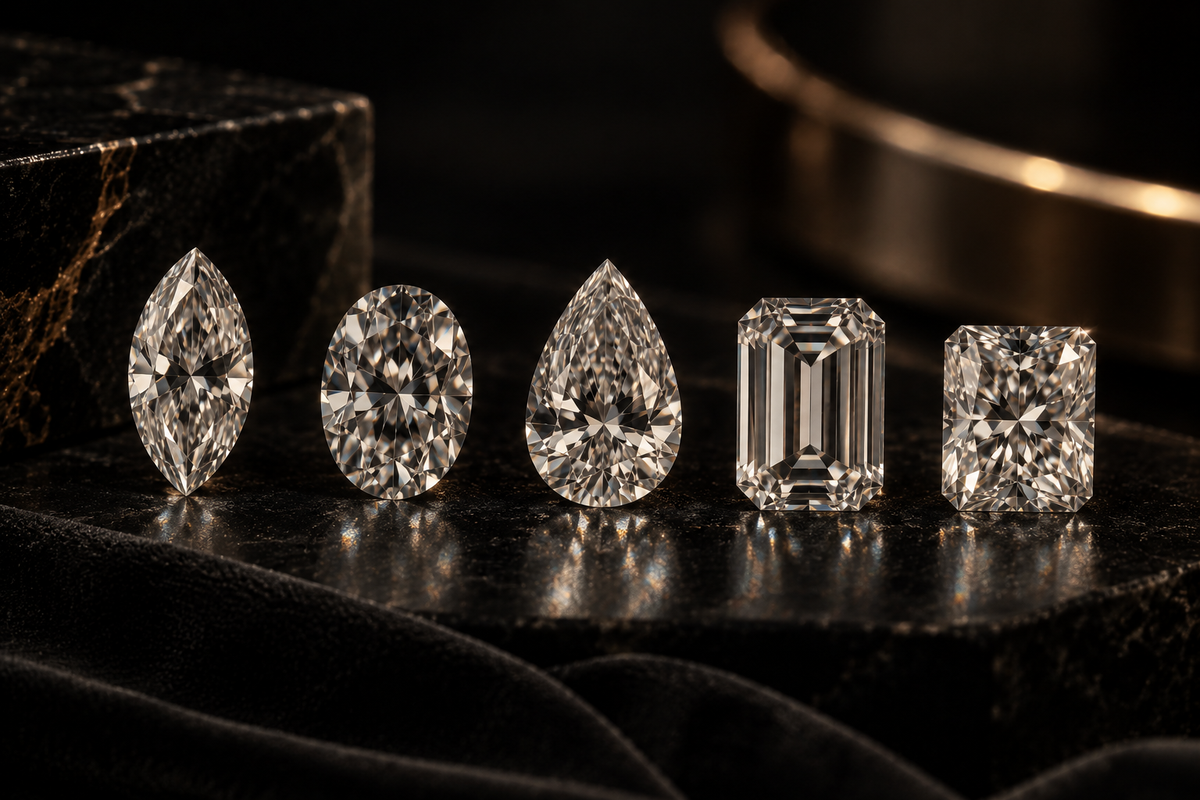
If your goal is to get the biggest-looking diamond for its carat weight, start with elongated shapes such as marquise, oval and pear. These shapes can cover more visible space across the finger than compact shapes of the same weight. But there is no single shape that will always look the biggest: the diamond's actual length, width and proportions matter just as much as its shape. Carat tells you how much a diamond weighs; its millimeter measurements tell you much more about how large it will look from above.
So if you're shopping for a diamond and want maximum visual impact without simply increasing the carat, there's a better question to ask than "How many carats is it?" Ask yourself: "How much of the diamond will I actually see on my finger?"
What Makes One Diamond Look Bigger Than Another?
A diamond can look larger for two different reasons. The first is its shape. Long, narrow outlines such as marquise, oval and pear can create more visual length and finger coverage. Emerald is another shape that can have a substantial face-up presence because of its broad, open table.
The second is the individual stone's proportions. Two 1-carat diamonds don't necessarily have the same length and width. One may carry more of its weight in depth, while another may distribute more of that weight across its visible surface.
That's why choosing the biggest-looking diamond isn't as simple as choosing the highest carat number.
Carat Weight Is Not the Same as Diamond Size
This is one of the easiest diamond-buying details to misunderstand.
Carat is a measurement of weight. It does not directly tell you the diamond's visible dimensions.
If you're comparing two diamonds specifically for visual size, look at the measurements on their grading reports. IGI reports, for example, include the diamond's shape, measurements and carat weight alongside its other grading information. A useful rule is:
Carat tells you what the diamond weighs and millimeters tell you how much space it occupies. That distinction becomes especially important when you're comparing different shapes.
Which Diamond Shapes Tend to Look Biggest?
Rather than treating the following as a rigid ranking, think of them as strong options when visual size is your priority.

Marquise: Maximum Length
The marquise is one of the first shapes I'd consider if your main goal is to make a diamond look large. Its long outline stretches across the finger, giving the center stone a substantial presence without necessarily requiring a very high carat weight. The shape can also create a lengthening effect on the finger.
Best for: maximum visual length and a dramatic silhouette.
Check before buying: symmetry, width and the overall balance of the stone. An unusually narrow marquise may not give you the look you expect.
Oval: Size With Classic Sparkle
Oval is an excellent choice if you want a larger-looking diamond without an overly dramatic shape. Its elongated outline provides more finger coverage than a round diamond of comparable weight, while its brilliant-style faceting gives it plenty of sparkle. Blue Nile also identifies oval as one of the elongated shapes that can appear larger than round at the same carat weight.
Best for: a balance of visual size, sparkle and a classic look.
One thing to watch for is the bow-tie effect, a darker area that can appear across the middle of some elongated diamonds. Its intensity varies from stone to stone, so viewing the actual diamond is worthwhile.
Pear: A Long, Eye-Catching Silhouette
Pear-shaped diamonds combine a rounded end with a tapered point. That combination gives the stone an elongated outline and can create impressive finger coverage. It also gives you a shape that feels more distinctive than a traditional round or oval. Because of its pointed tip, the setting should also provide appropriate protection.
Best for: buyers who want a large-looking diamond with a more unusual silhouette.
Emerald: Broad and Visually Spacious
Emerald diamonds create their size effect differently. Their elongated rectangular outline and large table can give the stone a broad, open appearance. Rather than intense sparkle, emerald cuts are known for their long, step-cut facets and reflective, mirror-like look.
Best for: someone who wants a substantial-looking diamond with an elegant, understated appearance.
The trade-off is that emerald's open facets can make inclusions and color easier to notice, so appearance matters more than simply chasing measurements.
Radiant: A Size-and-Sparkle Middle Ground
Radiant diamonds can be square or elongated and combine a structured outline with brilliant-style faceting. That makes them useful if you want a noticeable face-up size without giving up sparkle.
Best for: buyers who want a substantial-looking rectangular diamond with plenty of brilliance.
|
Diamond shape |
Visual size |
Best for |
|
Marquise |
Very large-looking |
Maximum visual length |
|
Oval |
Large-looking |
Size + sparkle |
|
Pear |
Large-looking |
Elongated, distinctive look |
|
Emerald |
Broad-looking |
Elegant, substantial appearance |
|
Radiant |
Large-looking |
Size + brilliance |
|
Round |
More compact |
Maximum sparkle |
This isn't a fixed ranking for every diamond. Two stones with the same shape and carat weight can still look different because their proportions and measurements vary.
How Do You Know Which Diamond Is Actually Bigger?
This is where I would look beyond the shape name.
For example, imagine you're comparing two 1-carat diamonds:
Diamond A: 6.5 × 6.5 mm
Diamond B: 8.0 × 5.5 mm
Although both weigh 1 carat, their proportions are very different. Diamond B has a longer outline and may provide more noticeable length across the finger.
What Should You Check on a Diamond Report?
If you're trying to find a bigger-looking diamond, check these details:
1. Length and width: These help you understand the diamond's visible footprint from above.
2. Depth: A deeper stone can carry more of its weight below the surface rather than across the top.
3. Shape: Elongated shapes generally offer more visible coverage.
4. Proportions: Two diamonds of the same shape can still look very different.
5. Cut quality: Size isn't everything. A diamond that looks large but performs poorly in light may not look as attractive as a slightly smaller, well-cut stone.
For fancy shapes, there is also no single universal set of "perfect" proportions. Individual cutting styles can vary, so comparing the actual stone is more useful than blindly following one ratio.
How Can You Make a Diamond Look Bigger?
You don't necessarily need to increase the carat weight to make your ring look more substantial.
Choose an elongated shape
Marquise, oval and pear are natural starting points if finger coverage is your priority.
Compare actual measurements
If two diamonds have the same carat weight, check their length and width before deciding which one looks larger on paper.
Consider the setting
A halo can visually expand the overall footprint of the ring, while an open solitaire can keep attention focused on the center stone.
Keep the band proportionate
A very wide band can make a center diamond appear smaller by comparison. A slimmer band can give the stone more visual prominence.
Don't ignore cut quality
A diamond isn't attractive simply because it occupies more space. Brightness, contrast and light performance still affect how noticeable the stone looks.
What About Lab-Grown Diamonds?
A lab-grown diamond does not inherently look bigger than a natural diamond of the same shape, carat weight and proportions. Its visible size is still determined by its dimensions and how it is cut.
The potential advantage is the budget.
If you're choosing a lab-grown diamond, you may have more flexibility to spend your budget on a larger center stone, a shape with greater visual coverage or a well-proportioned diamond rather than putting all your attention on the carat number.
That's why I would compare lab-grown diamonds using the same checklist: shape + millimeters + proportions + appearance, rather than assuming a particular carat weight will automatically look large.
So, Which Diamond Shape Looks the Biggest?
-
For maximum visual length: Marquise
-
For size + classic sparkle: Oval
-
For an elongated, distinctive look: Pear
-
For broad, sophisticated coverage: Emerald
-
For size + brilliance: Radiant
The biggest-looking diamond isn't necessarily the one with the biggest carat number. It's the one that uses its weight well and gives you the right combination of shape, measurements and proportions.
At Emori, you can explore lab-grown diamond rings in different shapes and designs, so you can compare your options based on size, sparkle, setting and overall style rather than choosing solely by carat weight. Whether you prefer the elongated look of a marquise or oval, the distinctive silhouette of a pear, or the classic brilliance of a radiant, the right diamond is the one that looks beautiful on your hand and fits your budget.
Browse Emori's lab-grown diamond rings to find a shape and design that gives you the look you want without paying simply for a bigger number on the certificate.
Share:
I have ₹1,00,000. What lab grown diamond ring should I buy?
Which Diamond Shape Sparkles the Most?