

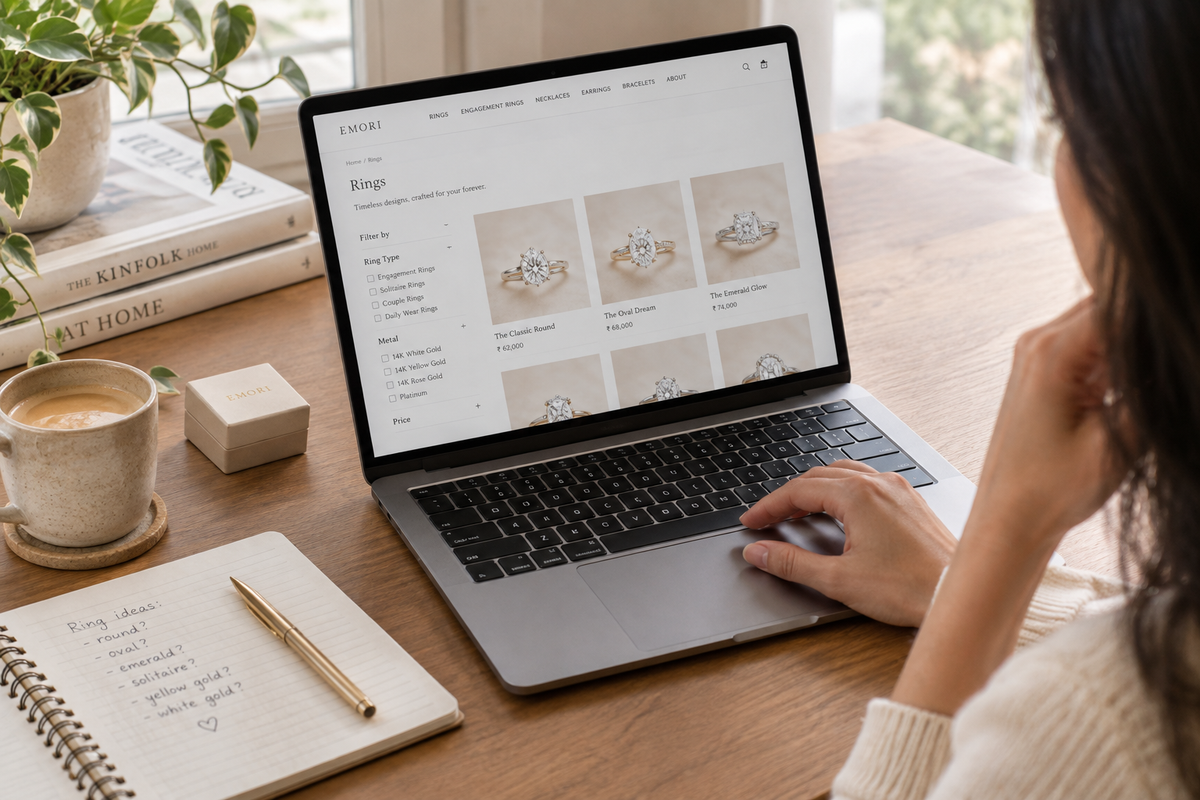
Buying an engagement ring can begin with a simple question “What would they like?” and quickly turn into a maze of diamond shapes, carat weights, metal colours, certifications, prices and opinions from everyone who has ever bought jewelry.
This guide takes you through the complete journey: understanding what an engagement ring means, finding the right style, choosing a diamond, comparing technical details, selecting the setting and metal, checking the fit, understanding the price and making the final purchase with confidence.
You do not need to become a diamond expert overnight. You simply need to know what to look for, what to compare and which questions to ask before you buy.
Understanding Engagement Rings
What Does an Engagement Ring Actually Represent?
An engagement ring is, technically, a symbol of a promise to marry.
But choosing one is rarely that simple. It becomes their ring, the piece they may wear every day, look at for years and eventually pass down. Which is why the best place to start isn't with carat size or diamond prices. It's with the person you're buying it for.
Think about what they already wear.
Do they reach for yellow gold every morning? Are their rings delicate and minimal, or do they like pieces that make a statement? Do they save clean, modern designs on Instagram, or are they drawn to vintage details? You don't need to secretly investigate their entire Pinterest history. Their existing jewelry will usually tell you more than you think.
What to take away: Start with their taste, not the diamond.
Anatomy of an Engagement Ring
An engagement ring is made up of three basic elements: the centre stone, setting and band. The centre stone is usually the diamond you notice first. The setting is the structure that holds it in place, while the band is the part that wraps around the finger.

Then come the details that change the personality of the ring: prongs, halos, pavé diamonds, side stones, cathedral shoulders and more.
Why does this matter? Because two rings can have the same one-carat diamond and still look completely different. One might feel delicate and understated. Another might look bold and substantial. The difference isn't necessarily the diamond. It's everything around it.
What's the Difference Between an Engagement Ring and a Wedding Ring?
The engagement ring is traditionally given when you get engaged. The wedding ring or band is exchanged at the wedding.
But there are no hard rules about how they need to look together.
Some couples want a matching pair. Some prefer contrast. Others want an engagement ring that stands completely on its own.
The one thing worth thinking about now is how the two rings will sit together later.
If you want the wedding band to sit flush against the engagement ring, the centre setting and band profile can make a difference.
A useful question to ask before buying: Will I want to wear a wedding band alongside this every day?
How to Find a Ring Style That Feels Right
Classic, Modern, Romantic or Statement?
You will come across plenty of labels when shopping for rings. Classic. Contemporary. Vintage. Minimal. Romantic. Statement. Useful, but don't get too attached to them.
A “classic” ring doesn't have to mean boring, and a “modern” ring doesn't have to mean unusual. These labels are simply a starting point for understanding the overall feel of a design.
A classic ring might be a simple solitaire with a round diamond.
A modern design could use a clean bezel setting, an East-West diamond or an unexpected band.
A romantic ring might introduce softer curves, halos or vintage-inspired details.
A statement design could use a larger centre stone, multiple diamonds or a more distinctive silhouette.
The better question is: What kind of jewelry would they actually choose for themselves? Because the ring should feel like an elevated version of their style, not a completely different person wearing jewelry.
What Can a Ring Style Tell You About Their Personal Style?
Look beyond engagement rings.
If their everyday jewelry is mostly thin gold chains and tiny hoops, a huge, heavily detailed ring may feel out of character.
If they already wear chunky rings, mixed metals or unusual shapes, a more distinctive engagement ring may feel much more natural.
Pay attention to:
-
The metal they wear most
-
Whether they prefer delicate or bold jewelry
-
Clean lines versus intricate details
-
Rounded versus geometric shapes
-
Whether they wear jewelry every day or mostly for occasions
You are not trying to predict their personality from a ring.
You're looking for patterns in what they already like.
How Should Lifestyle Affect the Ring You Choose?
This is where aesthetics meet real life.
An engagement ring can look incredible in a proposal photo and still be annoying to wear every day. If they work with their hands, exercise regularly, travel often or simply don't want to think about their jewelry too much, a secure setting and practical profile may matter more than an elaborate design.
A high-set diamond, for example, can create a beautiful presence, but it may also be more likely to catch on clothes, hair or bags. A bezel setting offers more protection. A lower profile can feel easier for everyday wear. A simpler band can also be easier to maintain than one covered in tiny stones.
None of these choices is universally better. The point is to match the ring to how they actually live.
Diamond Shapes Explained
Before we talk about carats, there's something more important to decide:
What shape do you actually like?
Diamond shape changes the entire personality of a ring. It also changes how large the diamond looks, how it reflects light and how it sits visually on the finger.
Round: Round brilliant is the classic for a reason. Its faceting pattern is designed to maximise light return, giving you the bright white sparkle most people associate with diamonds. It is also extremely versatile. Put a round diamond in a solitaire and it feels timeless. Add a halo and it becomes more glamorous. Pair it with a modern setting and it can feel completely contemporary.
What to check: Look for strong, even sparkle rather than choosing purely by certificate grade.
Oval: Oval diamonds give you an elongated silhouette while retaining the lively sparkle of a brilliant-style cut. One reason people love them is visual coverage: an oval can look larger across the finger than a round of similar carat weight.
But there is one detail you should always look for: the bow-tie. This is a darker area that can appear across the centre of an oval. Some degree is common, but a strong, distracting bow-tie can affect how lively the diamond looks.
What to check: Don't judge an oval from a single photograph. Move it, view it from different angles and look at how the centre behaves.
Emerald: Emerald cuts are a completely different kind of beautiful. Instead of lots of small, sharp flashes, their long step-cut facets create broad reflections and a distinctive hall-of-mirrors effect. The trade-off is that those large, open facets can make inclusions easier to notice. So if you're choosing an emerald cut, clarity deserves more attention than it might in a heavily faceted brilliant diamond.
What to check: Look closely at the centre of the stone and make sure inclusions aren't obvious to the naked eye.
Cushion: Cushion diamonds have softly rounded corners and a shape that can range from almost square to distinctly elongated. That variation matters. Two cushions with the same carat weight can look completely different because of their length-to-width ratio and faceting pattern. Some have a softer, romantic appearance. Others have stronger, more modern geometry.
What to check: Compare the actual measurements rather than assuming all cushions of the same carat will have the same presence.
Pear: The pear shape combines a rounded end with a pointed tip. That point creates its distinctive silhouette, but it also needs protection. A well-designed setting should protect the tip from everyday knocks, particularly because it is one of the more vulnerable areas of the diamond.
Marquise: Long, narrow and pointed at both ends, the marquise can create impressive finger coverage without needing an enormous carat weight. Because the shape is so directional, symmetry matters. If the two sides don't balance properly, you'll notice it.
Princess: The princess cut has a crisp, square or rectangular outline and a brilliant-style faceting pattern. It feels cleaner and more geometric than a round or cushion. Its sharp corners, however, should be adequately protected by the setting.
Radiant: Think of a radiant as a meeting point between geometry and sparkle. It has the structured outline of a rectangular shape but uses brilliant-style faceting for more active light return. If you like the clean look of an emerald but want more sparkle, it is a shape worth considering.
Asscher: Asscher cuts are square step cuts with deep, geometric facets. They're less about explosive sparkle and more about symmetry, depth and those dramatic broad flashes. If you like architecture, clean lines and vintage-inspired design, the Asscher has a very different personality from a brilliant cut.
Heart: The heart shape is unmistakably romantic, but getting the proportions right matters. The two lobes should look balanced, the cleft should be well defined and the point should be centred. It is one of those shapes where symmetry is especially easy to notice.
What Different Diamond Shapes Can Reflect

You will find plenty of claims online about what every diamond shape supposedly “says” about your personality.
Treat those as inspiration, not fact.
A round diamond isn't automatically traditional. An emerald cut doesn't automatically mean minimalist. And choosing a pear doesn't tell anyone who you are.
What shape can change is the visual character of the ring.
Round tends to feel timeless. The Oval can feel elegant and contemporary. Emerald feels refined and architectural. The cushion feels softer. Pear and marquise create more direction and movement.
The most useful question isn't “What does this shape say about me?” It's “Would I still love this shape if nobody else had an opinion?”
Diamond Cut, Sparkle and Proportions
Shape vs Cut: Why the Difference Matters
This is one of the easiest diamond terms to mix up.
Shape is what the diamond looks like from above: round, oval, pear, emerald and so on.
Cut is about how the diamond has been proportioned and faceted to interact with light.
So an oval is a shape. Its cut quality determines how successfully that oval returns light.
That's why two ovals can have the same carat weight and still look completely different.
Brilliant, Step and Modified Brilliant Cuts
There are three broad faceting approaches worth knowing.
Brilliant cuts use facets designed to maximise light return. Round brilliant is the classic example.
Step cuts use long, parallel facets that create broad flashes and a mirror-like effect. Emerald and Asscher cuts fall into this category.
Modified brilliant cuts adapt brilliant-style faceting to different shapes, such as radiant and many fancy cuts.
None is inherently better. They simply create different kinds of light performance.
What Actually Makes a Diamond Sparkle?
Three words help explain what you're seeing.
Brilliance is the white light reflected back from the diamond.
Fire is the flashes of colour created when light disperses through the stone.
Scintillation is the sparkle you notice as the diamond or your hand moves.
That last one is particularly important in real life.
A diamond isn't sitting under a showroom spotlight all day. It moves through sunlight, indoor lighting, restaurants, offices and phone screens. Good light performance should work across different environments.
Why Can Two Diamonds Look Different Even With Similar Grades?
Because a certificate doesn't capture everything your eye sees.
Two diamonds can have similar carat, colour and clarity grades but differ in:
-
Face-up dimensions
-
Proportions
-
Symmetry
-
Light return
-
Shape
-
Facet pattern
This is why comparing diamonds only by their certificates can lead you to miss what actually matters visually.
The expert approach: use the certificate to understand the diamond, then look at the diamond itself.
The Four Cs of Diamonds
The Four Cs are Cut, Colour, Clarity and Carat.
They're useful, but only if you understand what they mean in practice.
Cut: Cut has a major influence on sparkle. A well-proportioned diamond can return light beautifully, while poor proportions can make a stone look dull even when the other grades look impressive on paper. When comparing diamonds, don't ask only, “What grade is the cut?” Look at the actual light performance.
Colour: Diamond colour is graded from D to Z. At the top end, diamonds appear colourless. As you move down the scale, increasingly warm tones become visible. But colour perception depends on the diamond's shape and the metal around it. A little warmth may be barely noticeable in a yellow-gold setting, while it can be more apparent against a white-metal setting.
Clarity: Clarity measures inclusions inside the diamond and blemishes on its surface. But here's the practical bit: you don't wear a clarity grade, you wear a diamond. If a lower clarity stone looks completely clean to the naked eye, paying significantly more for a higher grade may not change what you see. This is where the term eye-clean becomes useful.
Carat: Carat measures weight, not size. That's an important distinction. A one-carat oval and a one-carat round do not necessarily occupy the same amount of space on the finger. So if visual size matters to you, look at the diamond's measurements as well as its carat weight.
You don't have to maximise every C. You might choose a slightly warmer colour because it works beautifully with yellow gold. Or choose a lower clarity grade because the diamond is eye-clean and put more of the budget towards cut quality or size. There isn't one perfect combination. The right balance depends on what you can actually see and what matters to you.
Diamond Size and Technical Details
Carat Weight vs Visual Size
If you want the ring to look substantial, don't start and end with a carat. Look at the diamond's millimetre measurements. A diamond with more face-up area can appear larger even when another stone weighs more. This is particularly important with elongated shapes such as oval, pear, marquise and emerald.
What Are Table, Depth and Length-to-Width Ratio?
Table is the large top facet of the diamond.
Depth is the measurement from the top of the diamond to the bottom.
Length-to-width ratio describes how elongated the shape is.
These numbers help explain why two diamonds of the same carat weight can look different.
There is no magic ratio that automatically makes a diamond beautiful. The ideal proportions depend on the shape and the look you're after.
What Are Symmetry, Polish and Fluorescence?
Symmetry describes how accurately the facets and shape line up.
Polish refers to the quality of the diamond's surface finish.
Fluorescence describes how a diamond reacts when exposed to ultraviolet light.
These details are worth knowing, but don't treat every grade as a simple good-versus-bad score. Look at how they affect the individual diamond.
What to verify: Ask for the full grading report, measurements and an actual view of the diamond, not just the headline carat and colour.
Natural vs Lab-Grown Diamonds
A natural diamond forms underground through natural geological processes over extremely long periods. A lab-grown diamond is created using controlled technology designed to reproduce the conditions under which diamonds form.
Both are diamonds. The key difference is origin only.
How Do Natural and Lab-Grown Diamonds Compare?
To the naked eye, a well-cut natural diamond and a well-cut lab-grown diamond can look the same. Their chemical composition and crystal structure are essentially the same. The differences buyers usually need to consider are origin, pricing, availability and personal preferences around sourcing. There is no need to make the decision more complicated than that.
What About Certification and Pricing?
A grading report helps document the diamond's characteristics and identify whether it is natural or laboratory-grown. When comparing prices, compare like with like. Look at the shape, carat, cut, colour, clarity, measurements, certification and origin, not just the price displayed next to the ring.
Engagement Ring Settings
The diamond gets most of the attention, but the setting determines how securely it sits, how much of it you see and how the ring behaves in everyday life.
What Are Prong, Bezel, Halo and Other Settings?
Prong setting: Small metal claws hold the diamond in place. Four prongs give a more open look, while six can provide additional security.
Bezel setting: A metal rim surrounds the stone. It offers strong protection and gives the ring a clean, contemporary feel.
Halo setting: Smaller diamonds surround the centre stone, adding sparkle and visual presence.
Pavé setting: Small diamonds are set closely into the band to create a continuous line of sparkle.
Cathedral setting: Raised shoulders support the centre stone, giving it a more elevated appearance.
Three-stone setting: A centre diamond is paired with two side stones, creating a broader, more balanced design.
Security vs Diamond Visibility
There is a natural trade-off between protection and exposure. More exposed settings can allow more light into the diamond and make the centre stone feel prominent.
More protective settings can shield the stone from everyday impact. Neither approach is universally right. The better choice depends on how the ring will actually be worn.
How Do You Choose a Setting for Everyday Wear?
Think about the person's routine. If they are constantly using their hands, a secure, lower-profile setting may be more practical.
If maximum diamond visibility is the priority, a more elevated setting can create that effect.
Also think about maintenance. Tiny pavé stones can create beautiful shine, but they introduce more small elements that need to be checked over time.
Engagement Ring Styles
Solitaire: One centre stone. No distractions. The solitaire is popular because it lets the diamond do all the talking. It is also one of the easiest styles to pair with different wedding bands later.
Halo: A halo surrounds the centre diamond with smaller stones. It can make the centre appear larger and add significant sparkle without putting the entire budget into a much larger centre stone.
Three-Stone: Three-stone rings combine a centre diamond with two side stones. Some people like the symbolism associated with past, present and future. Others simply like the broader silhouette. Either way, proportions matter. The side stones should feel balanced with the centre rather than competing with it.
Toi et Moi, Vintage, East-West and Other Styles: A Toi et Moi design places two stones side by side. A vintage-inspired ring may use milgrain, engraving, intricate metalwork or antique-style proportions. An East-West setting rotates an elongated diamond horizontally instead of placing it vertically.
These designs can feel more individual, but individuality should never come at the expense of wearability.
Choosing the Right Metal
Yellow Gold, White Gold, Rose Gold or Platinum?
The metal changes the overall character of the ring and how the diamond looks against it.
Yellow gold brings warmth and a classic feel.
White gold creates a bright, contemporary appearance.
Rose gold adds a softer, warmer tone.
Platinum has a naturally white appearance and is known for its durability.
If you're completely unsure, look at the jewelry they already wear. Their existing metal choices are usually your strongest clue.
14K vs 18K Gold
The number refers to the proportion of pure gold in the alloy.
18K gold contains a higher proportion of pure gold and has a richer gold content.
14K gold contains more alloying metals, which can make it harder and often more resistant to everyday wear.
The choice is a balance between gold content, colour, durability and preference.
What Should You Know About Hallmarking and Durability?
When buying precious-metal jewelry, check the stated metal purity and applicable hallmarking information.
Also ask about the construction of the ring, not just the metal itself. A ring can be made from a durable material and still have delicate details that require care.
Ring Design, Size and Fit
How Do Band Width and Ring Profile Change the Look?
Band width changes how substantial the ring feels.
A very thin band can make a centre diamond appear more prominent. A wider band can create a stronger, more contemporary look.
The profile describes the ring's shape and height when viewed from the side.
A high-profile ring can give a centre stone more presence but may feel more noticeable during everyday wear.
How Do You Find the Right Ring Size?
This is the part everyone wants to get right and often the part people try hardest to do secretly.
If you're planning a surprise, look at rings they already wear on the correct finger if possible. Ask a trusted friend or family member only if you know they can keep the secret.
But remember: finger size changes with temperature, time of day and even activity.
The safest option is professional measurement. If you're buying online, check whether the ring can be resized and what the limitations are before ordering.
How Do Shape and Band Design Affect the Finger?
Ring proportions can change how the finger appears. Elongated diamonds can create a lengthening effect. A wider band can make the ring feel more substantial. A delicate band can make the centre stone appear more prominent.
There is no universal “best” proportion. The goal is balance between the diamond, band, hand and overall design.
Engagement Rings and Wedding Bands
What Are Flush-Fit, Curved and Notched Bands?
A flush-fit wedding band sits directly against the engagement ring.
A curved band follows the shape of the engagement ring.
A notched band uses a more defined indentation to fit around the centre setting.
If having a seamless wedding-band stack matters to you, think about it before buying the engagement ring, not after.
Should You Match or Mix Metals?
Matching metals creates a coordinated look. Mixing metals can create contrast and make the stack feel more contemporary. There is no requirement for the engagement ring and wedding band to be identical. What matters is whether the combination feels intentional.
Personalising an Engagement Ring
What Details Can You Personalise?
Personalisation doesn't have to mean completely redesigning a ring. It could be a discreet engraving, a meaningful date, an unusual diamond orientation or a detail only the two of you understand. The best personalised details often aren't the most obvious ones.
Custom vs Ready-Made
A ready-made ring gives you a more straightforward buying process. You can see the finished design, assess the proportions and know what you're getting. Custom design gives you more control over the details.
It can be especially useful if you know exactly what you want or if you want several elements brought together in one design.
With custom jewelry, ask for clear information about the diamond, metal, dimensions, timeline, resizing and what happens if the final piece differs from the agreed design.
This is also where working with a jeweller that offers genuine design guidance can make the process much easier. You are not simply ordering a ring; you are making a series of design decisions.
How Much Does an Engagement Ring Cost?
What Actually Determines the Price?
The price of an engagement ring isn't determined by carat alone.
It can include:
-
Diamond quality and origin
-
Diamond shape
-
Cut and proportions
-
Metal type and weight
-
Setting complexity
-
Additional diamonds
-
Craftsmanship and making charges
-
Certification
-
Applicable taxes
This is why two rings that look similar in photographs can have very different prices.
What About Diamond, Gold, Making Charges, Certification and GST?
Think of the final price as the cost of the complete piece, not simply the diamond.
The diamond has its own value. The metal contributes to the cost. Then there may be making or craftsmanship charges, certification and applicable GST.
Ask for a clear price breakdown. You should be able to understand what you're paying for without having to reverse-engineer the quote.
How Do You Compare Two Rings?
Don't compare: ₹X vs ₹Y.
Compare: Diamond + proportions + certification + metal + setting + craftsmanship + after-sales support.
A cheaper ring is not automatically better value, and a more expensive ring is not automatically better quality.
The useful comparison is whether the difference in price corresponds to differences you actually care about.
Buying an Engagement Ring
What Should You Check Before Buying?
Before paying, confirm:
-
Exact diamond shape and carat
-
Diamond measurements
-
Colour and clarity
-
Cut information where applicable
-
Grading report or certification
-
Natural or lab-grown origin
-
Metal purity
-
Ring size
-
Final price and applicable taxes
-
Making charges
-
Resizing policy
-
Return or exchange policy
-
Warranty or after-sales support
If something isn't clear, ask. A good buying experience should leave you understanding what you bought.
What Should You Know About Buying Online?
Buying online can give you access to more designs and make price comparison easier. But don't let a beautiful product photograph do all the convincing.
Look for clear specifications, certification details, actual product images or videos, sizing information and transparent policies.
If the website doesn't clearly explain what you're buying, that's a reason to ask more questions, not a reason to guess.
What Should You Check About Certification, Returns, Resizing and Warranty?
These details matter particularly for an engagement ring because it is a long-term purchase.
Know who graded the diamond, what the report covers and whether the report corresponds to the stone you're receiving.
Then check the practical policies:
-
Can the ring be resized?
-
Within what period?
-
What happens if the ring doesn't fit?
-
What does the warranty cover?
-
What happens if a small stone becomes loose?
Read these details before paying, not when something goes wrong.
Common Engagement Ring Mistakes
Choosing Carat Before Understanding the Diamond. A larger number can be tempting. But carat tells you weight, not whether the diamond has good light performance, attractive proportions or even looks particularly large from above. Start with the diamond you like visually. Then understand its specifications.
Ignoring Proportions, Fit and Lifestyle
A diamond can be beautiful on its own and still be wrong for the finished ring. Think about the stone, setting, band, finger and lifestyle as one system.
Comparing Only Price or Certificate Grades
Certificates are important. Prices are important. Neither tells the entire story. The certificate tells you what the diamond is. The price tells you what you're being charged. You still need to decide whether the actual diamond and finished design are worth that price to you.
Caring for an Engagement Ring
How Should You Clean and Wear an Engagement Ring?
Regular gentle cleaning helps maintain the ring's appearance. But everyday habits matter too.
Remove the ring when doing activities that could expose it to harsh chemicals, heavy impact or unnecessary abrasion.
For routine cleaning, use appropriate jewelry-cleaning methods recommended for the specific metal and stones.
How Often Should a Ring Be Inspected?
Periodic professional inspection can help identify loose stones, worn prongs or other issues before they become bigger problems. If you notice a stone moving, a prong catching on fabric or a change in the ring's shape, don't wait for the next scheduled check.
What About Repairs and Resizing?
Resizing is not equally straightforward for every design. Intricate bands, eternity-style settings and rings with stones around the entire circumference can have more limitations. That is why understanding the resizing policy before buying is part of buying the ring, not an afterthought.
Engagement Ring Buying Checklist
Before you make the final decision, ask yourself:
About them
-
Does this look like something they would actually wear?
-
Does it fit their lifestyle?
-
Does the metal match what they usually wear?
About the diamond
-
Do I understand the shape?
-
Have I looked at the actual proportions?
-
Is it visually lively?
-
Is the clarity acceptable to my eye?
-
Do the measurements make sense for the carat weight?
-
Is the diamond properly certified?
About the ring
-
Is the setting secure?
-
Is the profile practical?
-
Will it work with a future wedding band?
-
Is the ring size correct or resizable?
About the purchase
-
Is the price clearly broken down?
-
Do I understand making charges and GST?
-
What are the return and resizing policies?
-
What does the warranty cover?
-
Who will help me if I have a problem later?
If you can answer those questions comfortably, you are no longer buying a ring because it looks nice.
You're making an informed choice.
Frequently Asked Questions
How many carats should an engagement ring be?
There is no correct carat weight. Choose based on your budget, the shape you prefer, the visual size you want and how the diamond performs, not a social expectation.
Is a bigger diamond always better?
No. Carat measures weight, not beauty or visual size. A well-proportioned diamond can look more impressive than a heavier stone with less favourable proportions.
Which diamond shape sparkles the most?
Brilliant-style shapes are designed to maximise light return, but sparkle also depends on cut quality, proportions, symmetry and the individual stone.
Is lab-grown a real diamond?
Yes. Lab-grown diamonds have essentially the same chemical composition and crystal structure as natural diamonds. The key difference is origin.
Is a higher clarity grade always worth paying for?
Not necessarily. If a diamond is eye-clean, a higher clarity grade may make little visible difference. The important question is what you can actually see.
Should I choose gold or platinum?
Look at both aesthetics and practicality. Yellow, white and rose gold create different visual effects, while platinum offers a naturally white appearance and strong durability. Their existing jewelry is also a useful clue.
Should I choose the diamond or setting first?
Either can work, but understanding the diamond shape first often makes the rest of the design easier. Once you know whether you're drawn to a round, oval, emerald or another shape, you can choose a setting that complements it.
How do I secretly find their ring size?
If it needs to stay a surprise, use a ring they already wear on the correct finger if possible and have it professionally measured. If that isn't possible, ask someone who knows their size, but only if they're good at keeping secrets. And always check the jeweller's resizing policy before buying.
Is a custom engagement ring worth considering?
Custom design can make sense when you want specific proportions, details or a design that isn't available as a ready-made ring. The important thing is not whether a ring is custom. It's whether the final design, craftsmanship and specifications match what you actually want.
The Final Decision
At some point, you have to stop comparing. Not because you've found the ring with the highest carat, the longest certificate or the most impressive price tag.
Because you've found a ring where the pieces make sense together. The diamond looks right. The setting suits them. The metal feels like something they'd actually wear. The proportions work on the finger. The ring fits their lifestyle. You understand what you're paying for. And you know what happens after you buy it.
That's the point of all the research. Not to become a diamond expert overnight. Just to get confident enough to recognise the ring that feels like them.
Share:
What’s the Best Diamond Shape for Everyday Wear?
Top-Rated Diamond Ring Designers Available for Custom Orders in India