

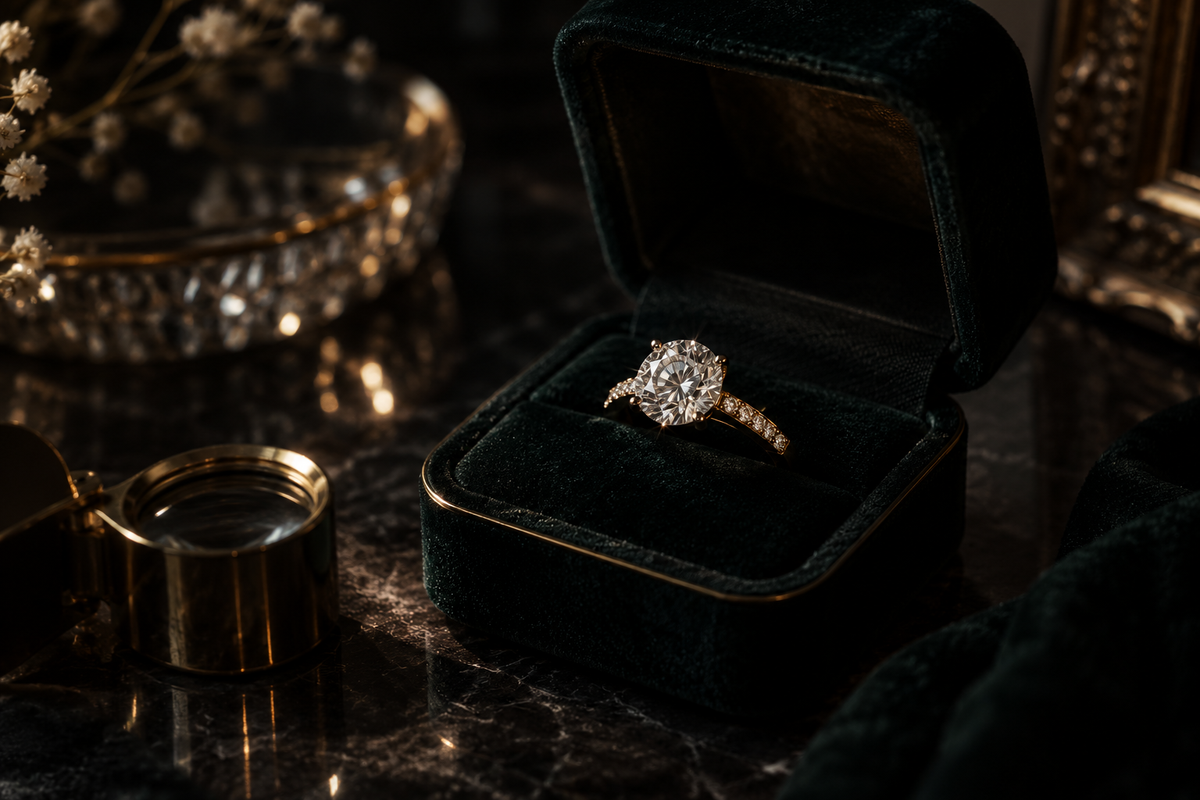
Wondering how to tell if a diamond ring is real? The most reliable way is to check the diamond’s grading report and, when necessary, have it examined by a qualified jeweller or gemological laboratory. Simple at-home checks can offer useful clues, but they cannot conclusively prove that a stone is a genuine diamond.
It’s also important to know that real does not necessarily mean natural. Lab-grown diamonds are real diamonds with essentially the same chemical composition and crystal structure as natural diamonds; the difference is how and where they form. Diamond simulants, such as cubic zirconia and moissanite, are different materials designed to resemble diamonds.
Whether you’re checking a ring you already own, buying a second-hand piece or considering a new diamond, knowing which tests are useful and which are unreliable can help you make a more informed decision.
How Can You Tell If a Diamond Is Real?
You can look for clues in a diamond’s appearance, documentation and physical characteristics, but no simple visual check can conclusively prove that a stone is a diamond. If you need certainty, a grading report or professional gemological examination is the better option.
Check the Diamond’s Certification
If the diamond comes with a grading report, check the details against the stone and verify the report number through the issuing laboratory where possible. A grading report provides information such as the diamond’s carat weight, colour, clarity and cut, helping you confirm that the stone matches its documented characteristics.
Examine How the Diamond Reflects Light
A well-cut diamond typically reflects a combination of white light (brilliance) and colourful flashes (fire). The way it interacts with light can provide a useful visual clue when comparing it with an imitation. However, sparkle alone cannot prove that a stone is a diamond. Moissanite and other diamond simulants can also appear highly brilliant, particularly under bright jewellery-store lighting. The diamond’s cut, shape and lighting conditions can also affect how much it sparkles.
What Are the Common Ways to Check If a Diamond Is Real at Home?

You can try a few simple checks at home to look for signs that a stone may be a diamond, but none can confirm authenticity on its own. Tests such as the fog test, read-through test and visual inspection are best used as preliminary checks rather than replacements for professional testing.
1. Check How the Diamond Reflects Light
Look at the stone under different lighting conditions. A well-cut diamond typically shows a combination of bright white reflections (brilliance) and flashes of colour (fire). However, don't use sparkle alone as proof. Moissanite and other diamond simulants can also be highly brilliant, and the amount of sparkle depends on the diamond's cut, shape and lighting.
2. Try the Fog Test
Gently breathe on the diamond to create a light layer of condensation on its surface. Because diamond conducts heat efficiently, the condensation may disappear relatively quickly.However, the fog test is not a conclusive way to identify a diamond. Temperature, cleanliness and the properties of other gemstones can affect the result, so don't treat a quick-clearing surface as proof that the stone is genuine.
3. Try the Read-Through Test
For a loose stone, place it table-down over a piece of printed text and look through it. If you can clearly make out the text, it may indicate that the stone's optical properties differ from those expected of a well-cut diamond.This test has significant limitations. The diamond's shape, cut, proportions, viewing angle and surroundings can all affect what you see, so use it only as a visual clue.
4. Examine the Stone Under Magnification
Using a jeweller's loupe can help you observe the stone more closely. You may notice inclusions, surface characteristics or other details that aren't visible to the naked eye.
But don't assume that an inclusion automatically means the stone is a natural diamond. Magnification alone cannot reliably distinguish a natural diamond, lab-grown diamond or simulant. Professional examination is needed when the stone's identity or origin needs to be confirmed.
Don't Use Scratch Tests
You may come across advice suggesting that you scratch glass or another surface with a diamond to test its hardness. It's best to avoid this. The test can damage the jewellery or the surface being scratched, while still failing to provide definitive proof of authenticity.
Think of home tests as clues, not confirmation. If the diamond is valuable or you are preparing to buy it, rely on its grading report or have it professionally examined rather than depending on a DIY test.
What Is the Most Reliable Way to Verify a Diamond?
The most reliable way to verify a diamond is through a grading report from a recognised gemological laboratory or a professional examination by a qualified gemologist. Home tests can provide clues, but they cannot reliably establish that a stone is a diamond.
Verify the Diamond’s Grading Report
If the diamond has a grading report, check that its details match the stone you are buying. Look for information such as the diamond's carat weight, colour, clarity, cut and identifying characteristics.
Where the laboratory provides online report verification, enter the report number on its official website and compare the results with the diamond and its documentation.
Get Professional Testing When in Doubt
If a diamond has no reliable documentation or you are unsure about its authenticity, a qualified jeweller or gemological laboratory can examine it using specialised equipment. Professional testing can distinguish diamonds from common simulants and, when appropriate testing is used, determine whether a diamond is natural or lab grown.
This is particularly useful when you're buying a high-value diamond, checking an inherited piece of jewellery or purchasing a second-hand ring.
What About Diamond Testers?
Basic thermal or electrical diamond testers can be useful for initial screening, but they should not be treated as the final word on a stone's identity or origin. For greater certainty, independent documentation and professional gemological testing are more dependable.
If you're making a significant purchase, don't rely on a single DIY test. Verify the documentation and, when necessary, have the stone professionally examined.
What Should You Check Before Buying a Diamond?
Before buying a diamond, don't rely on appearance alone. Check its grading report, quality characteristics, origin and the seller's policies so you know exactly what you are purchasing.
Check the Diamond's Grading Report
If the diamond comes with a grading report, make sure the information matches the stone and verify the report number through the issuing laboratory where possible. The report can help you understand the diamond's documented characteristics and provides greater confidence in your purchase.
Understand the 4Cs
The 4Cs: cut, colour, clarity and carat weight are the basic characteristics used to describe a diamond.
-
Cut: Affects how effectively the diamond interacts with light and contributes to its brilliance.
-
Colour: Describes how colourless the diamond appears.
-
Clarity: Refers to internal and external characteristics.
-
Carat weight: Measures the diamond's weight, not its size.
Two diamonds with the same carat weight can look and cost very differently depending on these characteristics, as well as their shape and overall craftsmanship.
Confirm the Diamond's Origin
Find out whether the diamond is natural or lab grown and make sure this information is clearly disclosed. A lab-grown diamond is a real diamond; its difference from a natural diamond is its origin, not whether it is genuine.
Choose a Transparent Seller
A reputable seller should clearly provide information about the diamond, jewellery specifications, certification where applicable, and relevant after-sales policies. Be cautious if important details are missing or if claims about the diamond cannot be verified.
Check the Return and Warranty Policies
Before paying, understand the seller's return, exchange and warranty terms. This is particularly important for engagement rings and other significant jewellery purchases.
Taking these steps before buying is far more useful than relying on a single DIY test after the purchase. The goal isn't simply to find a diamond that looks real—it is to understand exactly what you are buying and have confidence in the information provided.
How Can You Tell a Diamond From a Diamond Simulant?
Diamond simulants are materials that resemble diamonds but are not diamonds themselves. Common examples include cubic zirconia (CZ), moissanite and glass. They can look convincing to the naked eye, so appearance alone isn't always enough to tell them apart.
|
Stone |
Is it a diamond? |
What makes it different? |
|
Natural diamond |
Yes |
Forms naturally within the Earth |
|
Lab-grown diamond |
Yes |
Produced in a controlled environment but has essentially the same chemical composition and crystal structure as a natural diamond |
|
Moissanite |
No |
A different gemstone with different optical and chemical properties |
|
Cubic zirconia (CZ) |
No |
A synthetic material with different physical and optical properties |
|
Glass |
No |
A softer material with different optical properties |
Some simulants can have impressive brilliance and may look very similar to a diamond, particularly when set in jewellery. This is why sparkle, clarity or a single home test should not be treated as proof of authenticity. If you need to know exactly what a stone is, professional gemological testing is the more dependable option.
Conclusion
Knowing how to tell if a diamond is real starts with understanding that no single home test can prove a diamond's authenticity. Fog tests, visual checks and magnification can offer clues, but reliable documentation and professional gemological testing provide much greater confidence.It is also important to remember that lab-grown diamonds are real diamonds, while simulants such as moissanite and cubic zirconia are different materials that resemble diamonds.
Whether you're checking a diamond you already own or buying a new ring, focus on the bigger picture: verify the diamond's documentation, understand its quality and origin, and buy from a transparent seller. That way, you're not simply buying a stone that looks like a diamond you know what you're actually getting.
FAQs
1. How can you tell if a diamond ring is real at home?
You can check a diamond ring at home by examining how the stone reflects light, trying the fog test, and looking at it under magnification. For reliable confirmation, check the diamond’s grading report or have it examined by a qualified jeweller or gemological laboratory.
2. Can You Tell If a Diamond Is Real by Its Sparkle?
Sparkle alone cannot confirm whether a diamond is real. A well-cut diamond typically shows a combination of white light reflections (brilliance) and colourful flashes (fire), but diamond simulants such as moissanite can also appear highly brilliant.
3. What Is the Easiest Way to Check If a Diamond Is Real?
The easiest checks you can do at home include examining how the stone reflects light, trying the fog test and looking at it under magnification. However, these methods can only provide clues. If you want reliable confirmation, checking the diamond's grading report or having it examined by a qualified jeweller or gemological laboratory is a better approach.
4. Can a Jeweller Test If a Diamond Is Real?
Yes. A qualified jeweller or gemologist can examine a diamond using specialised testing equipment to determine whether it is a diamond or a simulant. If you also need to establish whether the diamond is natural or lab grown, appropriate professional testing and a reliable grading report can provide further information.
Share:
What Makes a Diamond Ring Look Expensive?
How to Choose a Diamond Ring They’ll Love for Years