

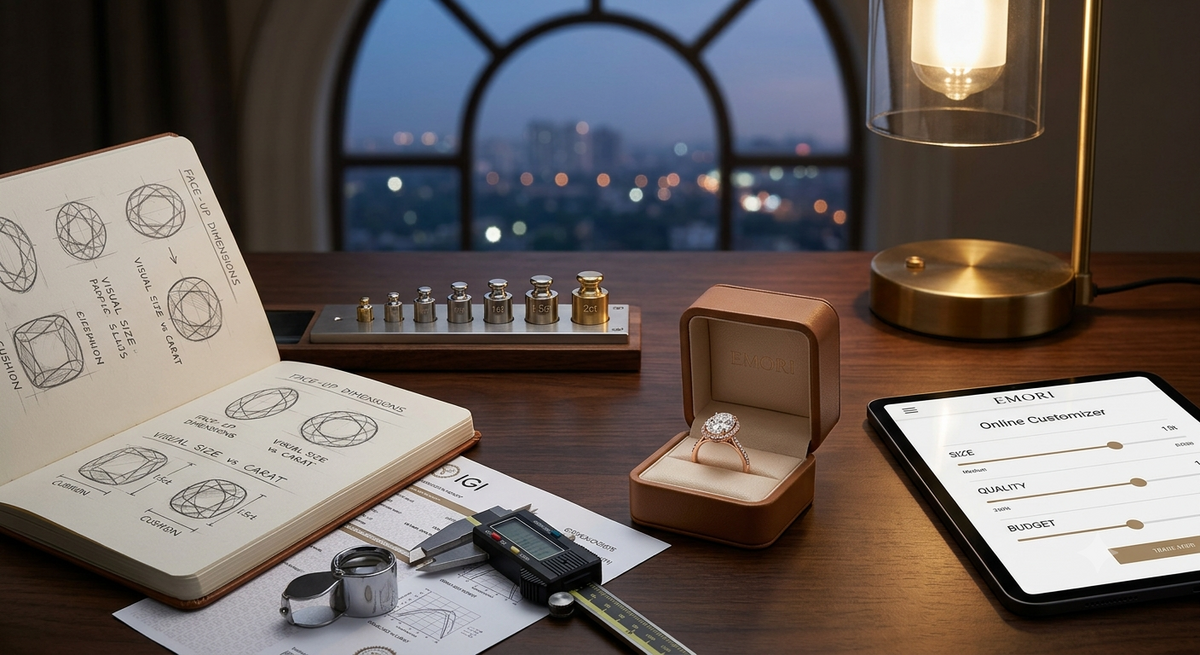
Balancing the size, quality and budget of a diamond ring means deciding which characteristics matter most to you instead of trying to maximise everything. Start with a comfortable budget, prioritise cut if sparkle matters to you, and then adjust carat weight, colour and clarity to achieve the appearance you want. If a larger-looking diamond is your priority, consider its shape, proportions and face-up dimensions rather than carat weight alone.
The right diamond is not necessarily the biggest or the highest-graded one. It is the combination of carat, cut, colour, clarity, shape and setting that gives you the look you want while staying within your budget.
A practical way to balance the three is to set your budget first, choose whether size, sparkle, colour or clarity matters most, and then adjust the other specifications around that priority.
How Do Size, Quality and Budget Affect Each Other?
The three factors are closely connected. A larger diamond generally costs more, while higher colour and clarity grades can also increase the price. This means that trying to maximise carat weight and every quality grade at the same time can quickly increase the overall cost.
Instead, decide which feature you notice most and allocate your budget accordingly.
|
Your priority |
Focus on |
You can be flexible with |
|
Larger-looking diamond |
Carat, shape and face-up dimensions |
Colour or clarity where visually acceptable |
|
More sparkle |
Cut quality and proportions |
Carat weight |
|
Colourless appearance |
Colour grade |
Size or other specifications |
|
Clean-looking diamond |
Eye-clean clarity |
Higher clarity grades that are not visibly noticeable |
|
Fixed budget |
Features that matter most to you |
Size, setting or other design details |
This approach is more useful than simply choosing the highest grade in every category. A diamond with a slightly lower colour or clarity grade can still have a beautiful appearance when those differences are not obvious to the naked eye.
Which Diamond Quality Factors Should You Prioritise?
The 4Cs of diamond quality cut, colour, clarity and carat give you a framework for comparing diamonds, but each factor affects the stone differently.
Cut influences how effectively a diamond interacts with light and is particularly important for brightness and sparkle. If brilliance is your priority, protecting cut quality can be more valuable than increasing carat weight.
Colour describes the degree of colour present in a diamond. How noticeable that colour is can depend on the diamond's shape and the metal used for the ring. You may therefore have some flexibility in colour grade depending on the appearance you prefer.
Clarity refers to characteristics such as inclusions inside the diamond and blemishes on its surface. The highest clarity grade is not always necessary for a diamond to look clean. An eye-clean diamond, where inclusions are not readily visible without magnification, can help balance appearance and budget.
Carat refers to the diamond's weight, not simply its visible size. Two diamonds with the same carat weight can have different proportions and face-up dimensions, so carat alone does not determine how large the stone will look.
When choosing between the 4Cs, focus on the differences you can actually see rather than paying automatically for the highest available grade.
How Can You Get a Larger-Looking Diamond Within Your Budget?
If size is important to you, look beyond carat weight. A diamond's shape, proportions and measurements can influence how much of the stone is visible from the top.
Elongated shapes such as oval, pear and marquise can have a larger-looking face-up appearance at a similar carat weight because of their proportions. Comparing the diamond's length and width alongside its carat weight can therefore give you a better idea of its visual presence.
The ring setting can also affect the overall appearance. A solitaire setting keeps attention on the centre diamond, while a halo setting uses smaller surrounding diamonds to create additional visual presence. The proportions of the band can also influence how prominent the centre stone looks.
So, if your budget does not allow you to increase carat weight, you can explore different shapes, measurements and settings to create the visual impact you want.
Where Should You Compromise on Diamond Quality?
There is no single quality factor that every buyer should compromise on. The better approach is to protect the characteristic that matters most to you and adjust the others where the difference is less noticeable.
If size is your priority, you can explore a larger carat weight while being flexible with colour or clarity, provided the diamond still has the appearance you want.
If sparkle is your priority, prioritise cut quality and consider choosing a slightly smaller diamond rather than sacrificing its light performance for additional carat weight.
If you want a very colourless appearance, you may prefer a higher colour grade and accept a smaller diamond within the same budget.
If you want a clean-looking diamond, consider eye-clean clarity instead of automatically paying for the highest clarity grade.
The goal is not to compromise on quality altogether. It is to understand which differences are visible and which specifications can be adjusted without changing the look you want.
A Simple Way to Choose the Right Diamond for Your Budget
Once you understand the relationship between size and quality, use this five-step approach:
1. Set your total ring budget
Decide how much you are comfortable spending on the complete ring, including the diamond, metal and setting.
2. Choose your main priority
Decide whether you care most about size, sparkle, colour, clarity or the overall ring design.
3. Protect the characteristics that affect appearance most
If sparkle matters, pay close attention to the cut. If visual size matters, compare shape and measurements as well as carat weight.
4. Be flexible with less noticeable differences
Look at colour and clarity in relation to the diamond's actual appearance rather than assuming the highest grade is always necessary.
5. Compare the complete specifications
Check the diamond's carat, cut, colour, clarity, shape, measurements and grading report before comparing prices.
This process helps you compare diamonds on more than one number and makes it easier to find a combination that fits both your preferences and your budget.
How Do Lab-Grown Diamonds Fit Into This Balance?
Lab-grown diamonds have essentially the same chemical composition, crystal structure and physical properties as natural diamonds.They can be evaluated using the same core diamond characteristics, including cut, colour, clarity and carat weight.
For buyers considering a lab-grown diamond ring, the same buying principle applies: decide your budget, identify your priorities and compare the complete diamond specifications rather than focusing only on size.
A grading report from a recognised gemological laboratory can provide documented information about characteristics such as carat weight, colour, clarity, cut and measurements. IGI and GIA are examples of gemological laboratories that issue diamond grading reports, although the specific report and grading details should always be checked for the individual diamond.
This makes certification useful when comparing diamonds because you can evaluate their documented characteristics alongside their appearance and price.
Diamond Ring Buying Checklist
Before choosing a diamond ring, check:
-
Budget: Is the complete ring within your comfortable spending limit?
-
Carat: Does the diamond provide the size you want?
-
Cut: Does it deliver the sparkle you expect?
-
Colour: Does its colour work with your preferred look and metal?
-
Clarity: Does it appear clean to the naked eye?
-
Shape: Does its face-up appearance suit your preference?
-
Setting: Does the design complement the centre diamond?
-
Grading report: Are the diamond's characteristics documented?
Looking at these factors together helps you make a more informed trade-off instead of choosing a diamond based on carat weight alone.
Find the Right Balance for Your Diamond Ring
The right balance between diamond size, quality and budget depends on what you want your ring to look like and which characteristics matter most to you. You do not need the largest diamond or the highest grade in every category to create a beautiful ring.
Start with your budget, prioritise the features you value most, and remain flexible where a lower specification does not make a noticeable difference to the diamond's appearance. Whether you are choosing a natural or lab-grown diamond, understanding the relationship between the 4Cs, shape, proportions, setting and budget can help you make a more confident choice.
With Emori's certified lab-grown diamond jewellery, you can explore different diamond shapes, sizes and ring designs to find a combination that fits your style and budget.
Frequently Asked Questions
Is it better to buy a bigger diamond or a higher-quality diamond?
It depends on your priority. If size matters most, you can consider a larger carat weight while being flexible with colour or clarity where the difference is not noticeable. If sparkle matters more, prioritising cut quality and choosing a slightly smaller diamond may give you a better balance.
Which diamond quality factor should I prioritise on a budget?
Cut is an important factor when sparkle and light performance are priorities. After that, consider colour and clarity based on what you can actually see rather than automatically choosing the highest grade available.
How can I make my diamond ring look bigger?
Consider the diamond's shape, proportions and face-up measurements rather than carat weight alone. Elongated shapes such as oval, pear and marquise can create a larger-looking appearance, while suitable settings can add further visual presence.
Can lab-grown diamonds be evaluated using the 4Cs?
Yes. Lab-grown diamonds can be evaluated for characteristics including cut, colour, clarity and carat weight. A grading report can provide documented information about these characteristics and help you compare individual diamonds.
Share:
Top-Rated Diamond Ring Designers Available for Custom Orders in India
Nine Nights, Nine Looks: How to Style Lab-Grown Diamond Jewellery for Every Night of Navratri