

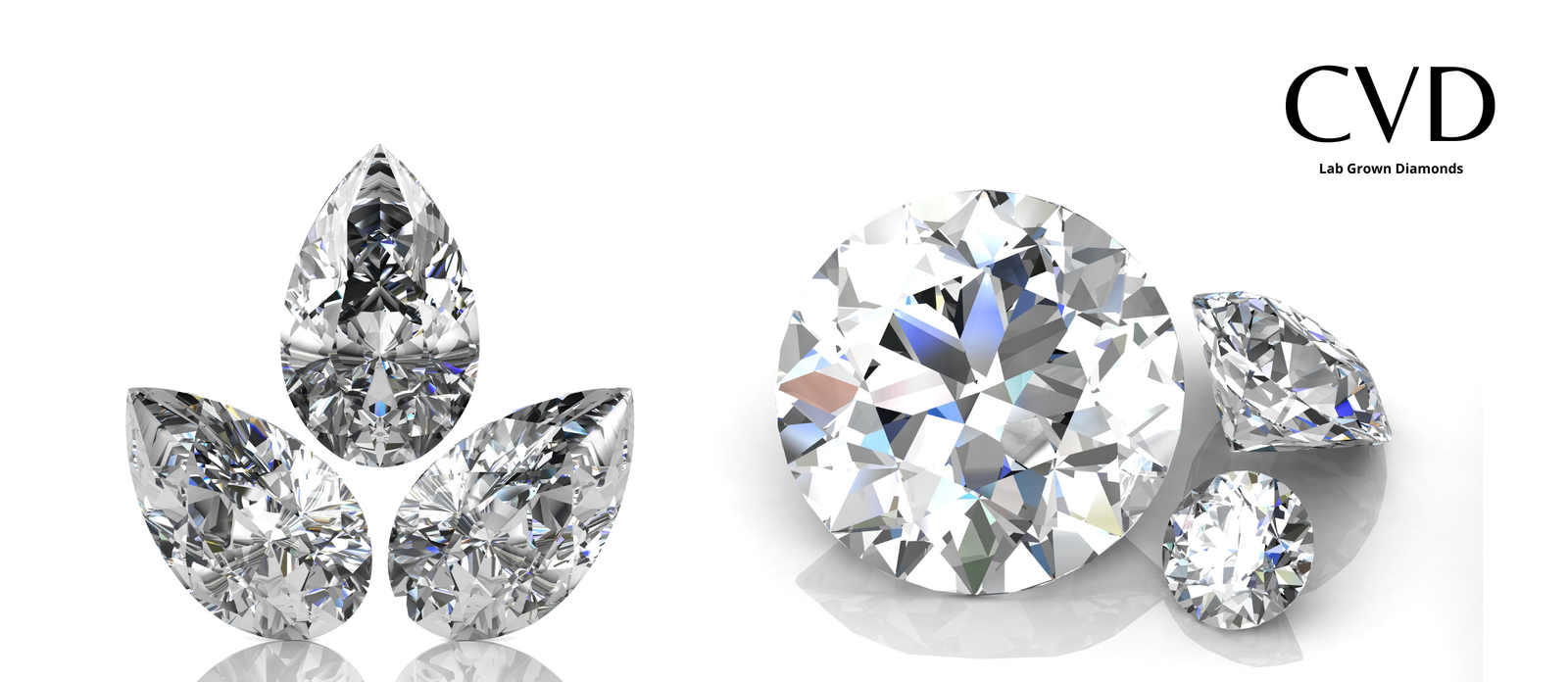
Have you ever wondered if a diamond grown in a lab can be 100 % real? Shopping for diamonds today is different from what we used to do decades ago. Earlier, it was about mined diamonds. But now there are terms like HPHT and CVD diamonds, often leaving buyers confused.
What makes them interesting is that they are not fake or trying to copy a real diamond. These are 100 percent pure visually, chemically and structurally, and the growing popularity of CVD diamonds has transformed the jewellery market. This guide will clear your confusion about what CVD diamonds are, their process, what they cost in India and whether they are the right choice for you.
What is CVD Diamond?
CVD Diamond full form is Chemical Vapour Deposition, a process used to manufacture these diamonds in the laboratory. CVD diamonds are 100% pure and real. They have the same carbon composition as natural diamonds. Natural diamonds take billions of years to form within the Earth, while CVD diamonds are formed in the same process in the lab just in weeks.
Many buyers prefer CVD lab grown diamond rings because they are environmentally friendly, ethical and more affordable.
How CVD Diamonds Are Made: Step-by-Step CVD Diamond Process
The process of manufacturing a CVD diamond is highly technical and fascinating. Understanding CVD diamond manufacturing will help clarify that they are real, genuine diamonds. The CVD process controls the quality and purity of the diamond.
Selection of Diamond Seed: CVD lab grown diamond growth starts with a tiny piece of a real diamond known as a diamond seed, 300 microns in size. The seed must be a Type 2nd A free of nitrogen as any impurities can affect final diamond growth. The quality of diamonds depends on the seed quality. Manufacturers carefully choose seeds based on crystal purity (mostly previously grown diamonds), structural stability and desired diamond shape, making them long-lasting.
Diamond Seed placement: Once the diamond seed is selected, it is cleaned to remove any dust, oil and contaminants at the surface. It is placed inside a sealed vacuum chamber known as a CVD reactor, having the conditions required for diamond growth. Then it is put on a substrate plate and heat and carbon which are needed for its growth. The chamber is properly sealed. It is designed to keep the pressure and gas flow and to support the plasma generation in order to create a favourable environment for diamond growth.
Introduction of Gases: After setting up the chamber, a mixture of gases, methane and hydrogen is introduced. Methane is a source of carbon, whereas hydrogen prevents graphite formation. The temperature of the chamber is maintained between 800 and 1200 °C to maintain the quality of the growing crystal.
Ionisation of Gases: It is the most technical part of the process. The chamber gets exposed to intense energy sources, microwave and laser energy. This warms gas molecules to extremely high temperatures and results in a plasma cloud inside the chamber. As this happened, the gas molecules broke apart into free, very reactive molecular particles called electrons. This converts the gas to a state called plasma. A plasma is a state in a chamber in which carbon particles get activated to build the diamond layer by layer.
Carbon Breakdown: Within the plasma environment, the methane molecules started to break down, creating free carbon atoms. At the same time, hydrogen plays a very important role to eliminate unwanted carbon atoms which are not needed for diamond formation and stops the growth of graphite inside the chamber. This is a very important chemical reaction, as an incompatible carbon atom can affect the purity and quality.
Diamond Growth: This is the step where the real diamond begins to grow. The released carbon atoms start to settle down one by one on the seed and crystallize atom to atom, continuously removing graphite or non-diamond carbon that forms on the surface of the seed. This ensures that only pure diamond carbon gets deposited. This process is slow, with a rate of 0.1 to 10 micrometres per hour and can continue for several days and even weeks.
A 1-carat CVD lab grown diamond generally takes around 3 to 4 weeks to fully form. This stage ends with a rough, darkly diamond crystal, black from the outside with a thin layer of graphite and a pure diamond inside.
Cutting, Polishing and Final Inspection: After a rich dark diamond is produced, it undergoes HPHT (High Pressure High Temperature) treatment, a short heating process that fixes its atomic structure and gives it a real colour.
Once treated, the rough diamond is cut into different shapes by experts. The diamond is then polished to bring out its real beauty. After polishing, it is certified by gemological laboratories IGI, GIA or SGL and gets evaluated on the basis of 4Cs: Cut, Color, Clarity and Carat weight.
Once certified, a CVD lab grown diamond becomes available in the market, which can be used in diamond engagement rings and for other special occasions.
Understanding the CVD diamond process is very important for buyers to understand the purity they carry with them, which makes modern CVD diamonds visually and structurally identical to natural diamonds.
CVD Diamonds VS HPHT Diamonds
The biggest difference between CVD and HPHT diamonds lies in their growth process. Below are the major differences between the two that will help buyers make a smart decision on purity and quality.
|
Factors |
CVD Diamonds |
HPHT Diamonds |
|
Full Form |
Chemical Vapour Deposition |
High Pressure High Temperature |
|
Manufacturing Process |
Carbon rich gases on Diamond Seed |
Extreme pressure and heat on carbon source |
|
Carbon Purity |
100% pure carbon |
May contain metallic traces |
|
Diamond Type |
Type IIa almost |
Type Ib or Type IIa |
|
Color Type |
Brown or grey tint |
Yellowish and Orange |
|
Price (approx. 1 carat) |
₹90k–1.1 lakh |
₹80k–1.2 |
|
Growth Time |
3- 4 weeks |
2-4 weeks |
|
Crystal Shape |
Flat plates |
Cubic and Octahedral Faces |
CVD Diamond vs Natural Diamond
At first glance, both look similar, and there are no chemical or physical differences between CVD and natural diamonds. In reality, CVD diamonds are Type 2nd A diamonds, the pure form of diamond. Over 98 per cent of natural diamonds contain nitrogen impurities, whereas CVD diamonds are nitrogen-free due to their controlled, lab-grown environment; i.e., technically, they are purer than natural diamonds.
The only differences between CVD and Natural diamonds lie in their manufacturing processes and prices. Natural diamonds are formed in the mantle over billions of years under heat and pressure, whereas CVD diamonds are grown in a lab in 2-4 weeks.
A CVD diamond costs 70-80 % less than natural diamonds, and ethically, they are environmentally friendly with no land destruction and human rights concerns.
CVD Diamond vs Moissanite
Moissanite is a completely different gemstone with different chemical and physical properties from CVD diamond. Here are the differences between CVD diamond and Moissanite.
|
Factors |
CVD Diamonds |
Moissanite |
|
Composition |
Carbon |
Silicon Carbide |
|
Stone Used |
Real Diamond |
Diamond Simulant |
|
Sparkle |
White |
Rainbow |
|
Hardness |
10 |
9.25 |
|
Price |
Expensive than moissanite, long term luxury value |
Budget friendly, good for big stones |
|
Certifications |
IGA/GIA |
Separate Certification |
|
Resale |
High Resale Value |
Low Resale Value |
Moissanites are generally the alternative to diamonds. Both diamonds are beautiful, durable and popular in jewellery. For buyers looking for authenticity, natural brilliance, and true diamond properties, CVD diamonds remain an alternative to mined diamonds. But moissanite is a budget-friendly option for those who prioritise affordability over diamond authenticity.
CVD Diamond Hardness: Are They Durable for Daily Wear?
CVD diamonds are durable in the long term as they are real diamonds with the same chemical composition and hardness as natural diamonds. CVD diamonds hardness is measured on the Mohs Hardness Scale. This scale measures hardness between 1 and 10, with CVD diamonds ranked at 10 on that scale. This hardness level makes CVD diamonds perfect for daily wear jewellery.
Things to Check Before Buying CVD Diamonds Online
-
Before buying CVD diamonds online, always ask for certification from the seller and verify the authenticity of the certificates.
-
Check for 4Cs, as they reflect the quality, appearance and purity of CVD diamonds.
-
Always ask for real videos and photos of the diamond. This helps in understanding the sparkle, quality and overall appearance.
-
Before placing an order, understand the return and exchange policies first for any future needs and confidence.
-
Choose a CVD diamond jewellery that suits your lifestyle and daily needs.
Choosing CVD diamond jewelry is a smart decision when done carefully. By checking the certifications, diamond quality and transparency. At Emori, modern CVD diamond jewellery is designed with durability, elegance and style for your special occasions and daily wear. We aim to provide buyers clarity, so they know exactly what they are investing in.
Share:
Types of Necklace Everyone Should Know before choosing their Necklace Style
5 Lab Grown Diamond Necklaces You Should Consider Investing In