

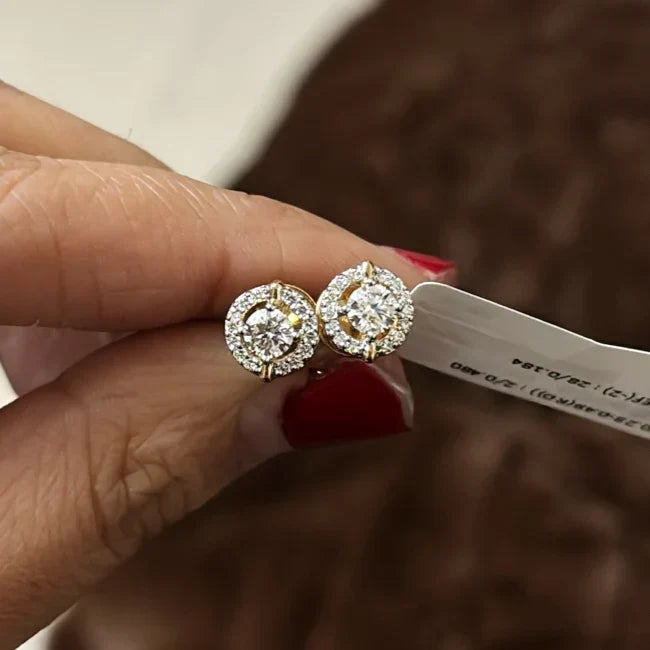
You are looking at a 1 carat lab grown diamond ring for Rs 45,000. The same quality mined diamond? Closer to Rs 3 lakhs. The savings feel incredible. But before you buy, one question stops almost every Indian buyer in their tracks — what happens to this diamond's value later? Can I sell it? Will I get anything back? Is this actually a smart investment?
These are fair questions. And they deserve honest answers, not marketing language.
What is the Resale Value of Lab Grown Diamonds in India?
Lab grown diamonds do have resale value in India, but it is lower than mined diamonds. On the open secondary market in 2026, you can realistically expect to recover 20% to 40% of your original purchase price. For context, mined diamonds typically return 40% to 60% on open market resale.
The reason for the gap is straightforward. Lab grown diamond production costs have fallen 20 to 30 percent since 2023 as global manufacturing scaled rapidly. A buyer in the secondary market always compares against what a new stone costs today, and new stones are getting cheaper every year. This puts downward pressure on resale values.
The Absolute Loss Calculation
However there is an important distinction most buyers miss. The absolute loss on a lab grown diamond is often the same or less than on a mined diamond. A 1 carat mined diamond purchased for Rs 2,50,000 that returns 50 percent gives you Rs 1,25,000 back. A 1 carat lab grown diamond purchased for Rs 45,000 that returns 30 percent gives you Rs 13,500 back. The percentage is lower but so is the actual money lost. And the Rs 2,05,000 you saved upfront more than compensates.
Why Lab-Grown Diamond Prices Adapt Over Time
Understanding why lab grown diamonds depreciate is not complicated once you see the economics behind it.
When a natural diamond is mined, it takes billions of years to form and significant cost and effort to extract. That scarcity keeps prices relatively stable over time. Lab grown diamonds work differently. They are created in a matter of weeks using advanced CVD (Chemical Vapor Deposition) or HPHT (High Pressure High Temperature) technologies that improve every year.
As production becomes faster and more efficient, manufacturing costs fall and so do prices. Lab grown diamond prices in India have dropped 20% to 30% since 2023 alone, and this trend is expected to continue.
Think of it like buying a smartphone. A phone that costs Rs 50,000 today will likely be available for Rs 30,000 in two years because better models arrive at lower prices. The phone you own does not become worse but the market value of it falls simply because newer versions are cheaper. Lab grown diamonds follow the same logic.
This matters for resale because anyone buying a second hand lab grown diamond will compare its price against what a brand new stone of the same quality costs today. If new stones are 30 percent cheaper than when you bought yours, buyers will expect a significant discount on the secondary market.
This is not a reason to avoid lab grown diamonds. It is simply a reason to buy them the right way, from a brand that offers structured exchange and buyback policies that protect your investment regardless of what happens to market prices.
The Definitive 2026 Lab-Grown Diamond Price Table
The table below outlines honest market rates for premium-grade, CVD (Chemical Vapor Deposition) diamonds—the gold standard for fine jewelry.
To give you a completely realistic picture, these numbers show the price of the loose stone on its own, followed by the total estimated cost when it is professionally set into a classic 14KT hallmarked gold solitaire ring.
| Carat Weight | Top-Tier Grade (DEF Color / VVS Clarity) | Estimated Loose Stone Price | Total Ring Price (Set in 14KT Gold) | Real Savings vs. Earth-Mined Equivalent |
| 0.50 Carat | IGI / GIA Certified | ₹12,000 - ₹22,000 | ₹25,000 - ₹45,000 | Save ~75% |
| 0.75 Carat | IGI / GIA Certified | ₹18,000 - ₹32,000 | ₹30,000 - ₹58,000 | Save ~78% |
| 1.00 Carat | IGI / GIA Certified | ₹25,000 - ₹45,000 | ₹35,000 - ₹75,000 | Save ~80% |
| 1.50 Carat | IGI / GIA Certified | ₹42,000 - ₹75,000 | ₹60,000 - ₹1,10,000 | Save ~80% |
| 2.00 Carat | IGI / GIA Certified | ₹70,000 - ₹1,20,000 | ₹90,000 - ₹1,60,000 | Save ~82% |
| 3.00 Carat | IGI / GIA Certified | ₹1,80,000 - ₹3,00,000 | ₹2,20,000 - ₹3,80,000 | Save ~85% |
Inside the Math: Why Lab-Grown Pricing Isn't a Straight Line
A common mistake first-time buyers make is assuming that a 2-carat diamond should simply cost exactly double what a 1-carat diamond costs.
In reality, diamond pricing operates on an exponential curve. Even though diamonds are grown inside a laboratory, physics still applies. Replicating the extreme heat and pressure needed to grow larger, flawless carbon crystals takes a significantly longer time and requires far more energy.
Because the failure rate during the growth cycle jumps dramatically as the diamond gets larger, a 2-carat or 3-carat rough crystal is significantly rarer and more expensive to manufacture per carat than a smaller stone.
Three Essential Rules to Avoid Overpaying
If you want to stretch your budget intelligently without sacrificing a single ounce of sparkle, use these three industry-insider strategies:
1. Opt for Fancy Shapes to Save 10% to 20%
The classic Round Brilliant cut is the most expensive shape on the market. This isn't because it's inherently better, but because the cutting process wastes up to 60% of the raw diamond crystal. "Fancy shapes" like Ovals, Pears, Cushions, and Emerald cuts waste significantly less raw material during polishing. Choosing an elegant oval or elongated cushion cut gives you a diamond that often looks visually larger face-up while costing 15% less than a round stone of the exact same weight.
2. Spot the Hidden "Making Charges"
Many retailers lure you in with an incredibly low loose diamond price, only to hit you with inflated "making charges" or heavily marked-up gold rates at final billing. When comparing options, always ask for an itemized invoice that completely separates the cost of the stone, the exact weight and current rate of the gold, and the labor charges.
3. Demand Uncompromising Certification
Never buy a lab-grown diamond based purely on a jeweler’s verbal promise. Uncertified stones or in-house shop certificates are often graded loosely, passing off lower-grade stones as premium quality. Always ensure your diamond comes with a verifiable certificate from a trusted, independent international authority like the International Gemological Institute (IGI) or the Gemological Institute of America (GIA).
Why Smart Buyers Choose the Emori Standard
1. Lifetime Exchange & Buyback Guarantee
The biggest psychological barrier for lab grown diamond rings buyers in India is the fear of zero liquidity. Emori addresses this directly by offering a brand-backed safety net:
-
90% Lifetime Exchange: Trade in your jewelry at any time to upgrade to a larger stone or a new design, retaining nearly the full value of your original diamond purchase.
-
80% Lifetime Cash Buyback: If you ever need immediate cash liquidation, you can return the jewelry for a direct cash refund.
-
100% Gold Value: For both exchange and buyback, the metal is valued at the prevailing market gold rates without any deductions.
2. Radical Transparent Pricing
Instead of bundling costs into a single, confusing lump sum to hide massive retail margins, Emori breaks down the invoice completely:
-
Itemized Costs: You see exactly what you are paying for the certified diamond, the gold weight, and the manufacturing labor.
-
Source Savings: By operating direct supply lines with diamond cutting centers in Surat, they bypass legacy broker markups.
-
Guaranteed Quality: Every piece is paired strictly with independent lab certifications from agencies like the International Gemological Institute (IGI) or GIA, along with BIS-Hallmarked gold.
3. Shark Tank Credibility
A lifetime policy is only as solid as the company backing it. Emori cemented its brand trust on a national scale during Shark Tank India Season 5:
-
The Showdown: In a rare category match-off against a direct competitor, Emori secured a high-profile investment from four Sharks.
-
The Validation: The panel backed the brand due to its strong business fundamentals, clear market positioning, and realistic scalability under its founder's leadership. This appearance transformed Emori from a digital startup into a widely trusted household name.
FAQS:
1. Are lab-grown diamonds a good investment?
No, they are not a good financial investment asset, but they are an exceptional lifestyle investment.
Like a luxury car or a smartphone, lab-grown diamonds depreciate in market value immediately after purchase and will not appreciate over time. However, because they cost up to 80% less than natural diamonds, they act as a "smart investment" for your wallet—allowing you to keep your primary capital safely in your bank account, stocks, or real estate from day one while still enjoying identical diamond luxury.
2. Do lab diamonds go down in value?
Yes, lab-grown diamond prices go down over time due to rapidly advancing technology and scaling production.
As laboratories in hubs like Surat become faster and more efficient at growing pure carbon crystals, manufacturing costs drop. Because the secondary resale market always judges a pre-owned diamond against what a brand-new stone costs today rather than what it cost years ago, older lab-grown diamonds naturally face high depreciation on the open market.
3. Why can't you resell lab-grown diamonds?
You can resell them, but traditional local jewelers will often refuse to buy them back because they can source brand-new factory stones for cheaper.
Traditional open-market jewellers lack a standardized buyback framework for lab-grown stones and prefer to avoid the market's technological price shifts. To completely bypass this issue, you must avoid the generic open market and buy exclusively from brands like Emori that guarantee value security through contract-backed, structured 80% Lifetime Buyback and 90% Lifetime Exchange policies.
4. What is the price of 1 carat lab-grown diamond in India?
In 2026, a premium 1-carat loose lab-grown diamond (DEF Color, VVS Clarity) in India costs between ₹25,000 and ₹45,000.
If you want the diamond set into a classic 14KT hallmarked gold solitaire ring, the total price typically ranges from ₹35,000 to ₹75,000. This price is significantly lower than a natural diamond of the same grade—which easily commands closer to ₹3 Lakhs—because India’s massive cutting and polishing infrastructure removes expensive international middleman markups.
Share:
Engagement Ring Finger for Women and Men: What it means in India?
10 Unique Diamond Mangalsutra Designs for the Modern Bride